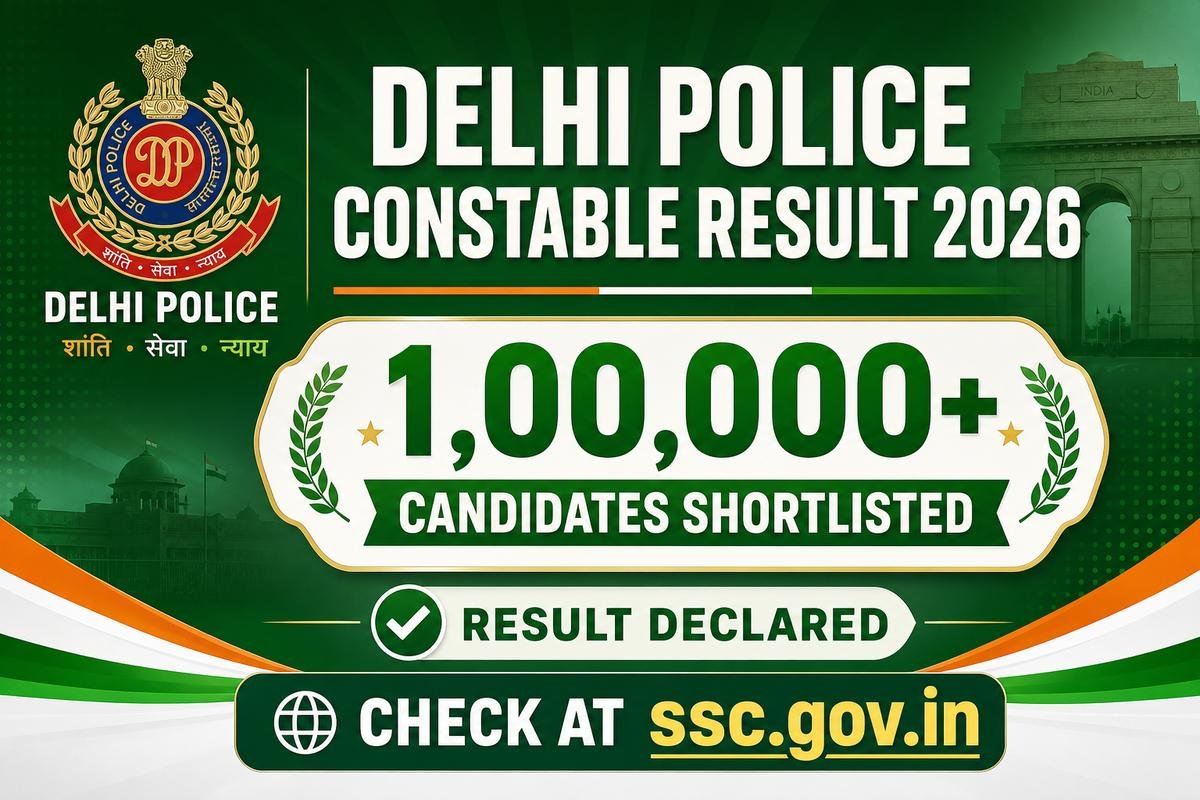
SSC has declared Delhi Police Constable (Executive) CBE Result 2026. Over 1 lakh candidates shortlisted for PE&MT and Document Verification. Check at ssc.gov.in. / SSC ने दिल्ली पुलिस कांस्टेबल (कार्यकारी) CBE परिणाम 2026 घोषित किया। 1 लाख से अधिक अभ्यर्थी PE&MT के लिए शॉर्टलिस्ट।
Delhi Police Constable Result 2026 – Key Highlights
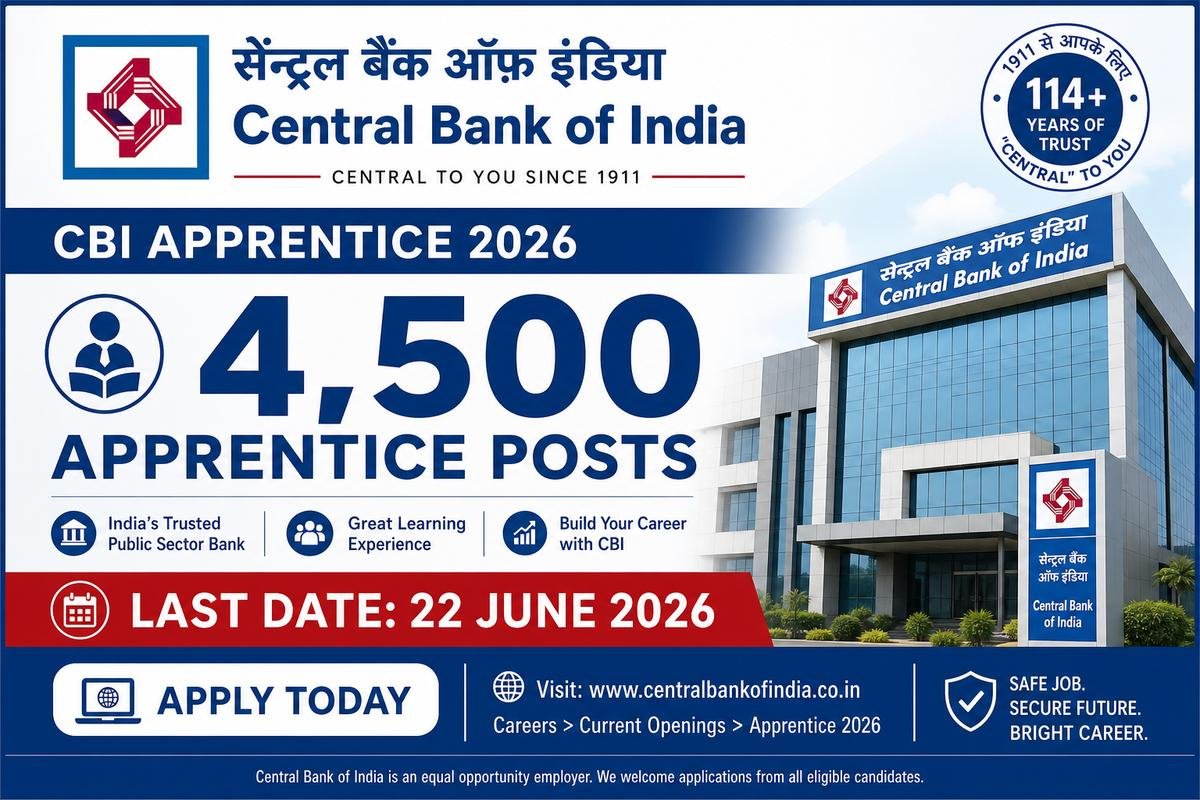
Central Bank of India (CBI) has released notification for 4,500 Apprentice Posts. Last date to apply online is 22 June 2026 (TODAY). Apply through NAPS/apprenticeshipindia.gov.in portal. / सेंट्रल बैंक ऑफ इंडिया ने 4,500 अप्रेंटिस पदों के लिए अधिसूचना जारी की है। ऑनलाइन आवेदन की अंतिम तिथि 22 जून 2026 (आज) है।
Important Dates / महत्वपूर्ण तिथियां
Event
Date
Notification Date
May 2026
Application Start
May 2026
Last Date to Apply
22 June 2026 (TODAY)
Selection Process
To be notified
Vacancy Details
Total Posts: 4,500 (Apprentice under Apprentices Act 1961)
Stipend: As per NAPS norms (~₹15,000/month)
Eligibility / पात्रता
Educational Qualification: Graduation from recognized university
Age Limit: 20-28 years
Must have valid registration on apprenticeshipindia.gov.in
How to Apply / आवेदन कैसे करें
Visit: apprenticeshipindia.gov.in (NAPS Portal)
Register/Login with your credentials
Search for “Central Bank of India” in establishments
📢 Registration Closed – SSC CGL 2026 का आवेदन 22 June 2026 को बंद हो चुका है।
Fee Payment की अंतिम तिथि: 23 June 2026 (11:00 PM) | Correction Window: 29 June – 1 July 2026
Short Information / संक्षिप्त जानकारी
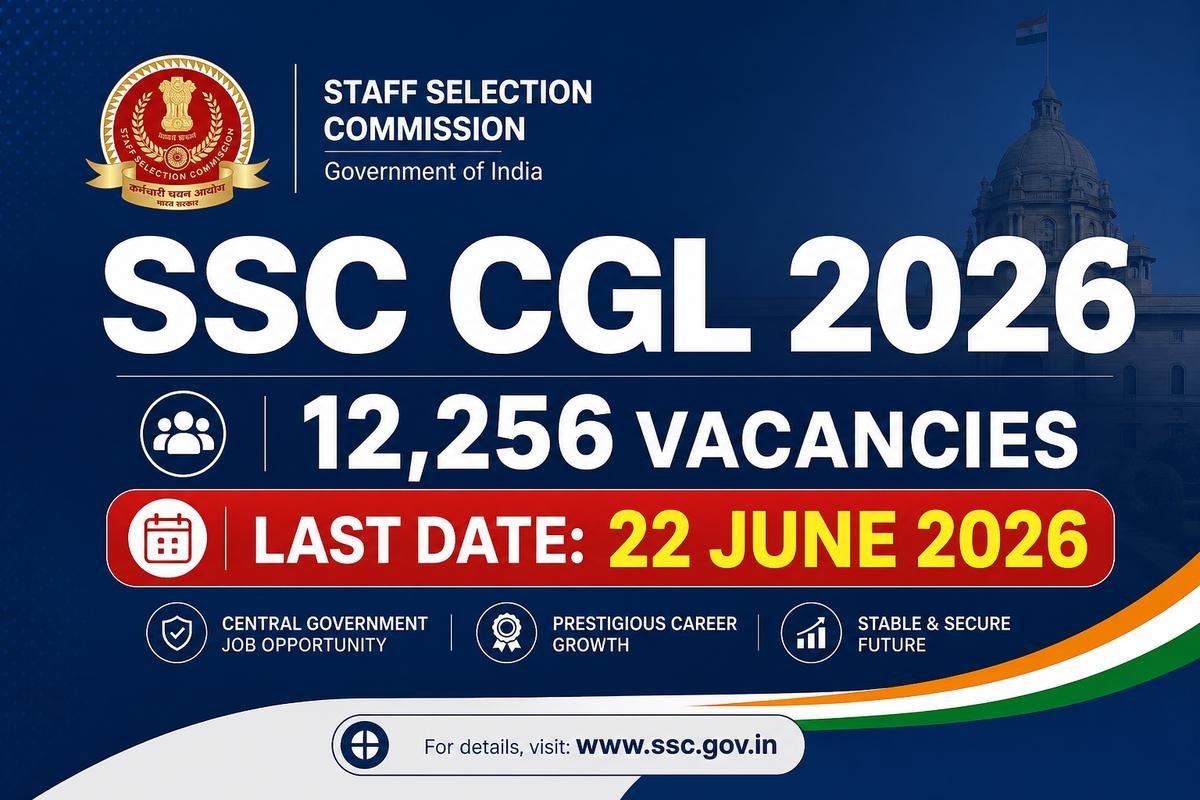
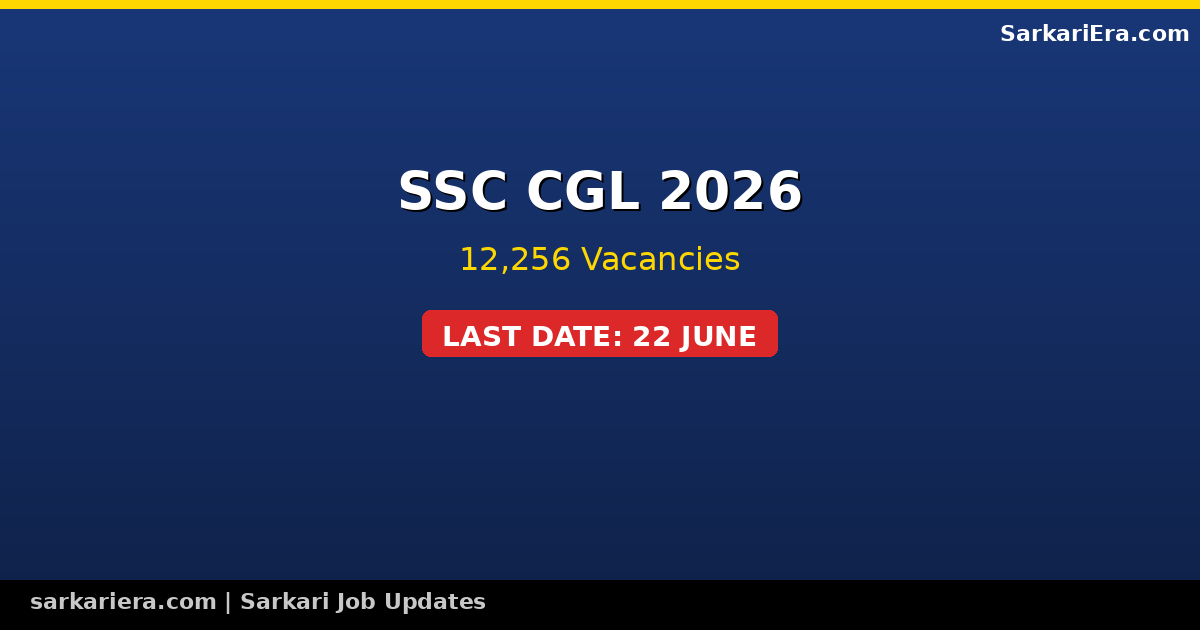
Staff Selection Commission (SSC) has invited online applications for Combined Graduate Level (CGL) Examination 2026. Last date to apply is TODAY – 22 June 2026. Total 12,256 vacancies for Group B & Group C posts. / SSC ने CGL परीक्षा 2026 के लिए ऑनलाइन आवेदन आमंत्रित किए हैं। आवेदन की अंतिम तिथि आज – 22 जून 2026।
SSC CGL 2026 – Important Dates / महत्वपूर्ण तिथियां
Event
Date
Notification Release / अधिसूचना
21 May 2026
Online Application Start / आवेदन शुरू
21 May 2026
Last Date to Apply / अंतिम तिथि
22 June 2026 (TODAY)
Tier-1 Exam (Tentative)
August-September 2026
Tier-2 Exam (Tentative)
December 2026
Application Fee / आवेदन शुल्क
Category
Fee
General / OBC
₹100
SC / ST / Women / PwBD / Ex-Servicemen
Free (Nil)
Age Limit / आयु सीमा
18-32 years (as on 01.08.2026). Age relaxation as per government rules for reserved categories.
Educational Qualification / शैक्षिक योग्यता
Bachelor’s Degree from a recognized university. / किसी मान्यता प्राप्त विश्वविद्यालय से स्नातक डिग्री।
Vacancy Details / रिक्ति विवरण
Total Posts: 12,256 (Group B & Group C) across various Ministries/Departments including:
Income Tax Inspector
Central Excise Inspector
Preventive Officer (Customs)
Assistant Section Officer (CSS)
Assistant Audit Officer
Divisional Accountant
Sub-Inspector (CBI/NIA)
Statistical Investigator Gr. II
And many more…
Selection Process / चयन प्रक्रिया
Tier-1: Computer Based Examination (100 marks, 60 minutes)
Tier-2: Computer Based Examination (multiple papers)
Document Verification
How to Apply / आवेदन कैसे करें
Visit official website: ssc.gov.in
Click on “Apply” → “CGL Examination 2026”
Register with valid email & mobile number
Fill application form with personal, educational details
Complete Syllabus, 60-Day Strategy & Best Books for 12,256 Vacancies
Exam Date: August-September 2026 (CBT)
Total Vacancies: 12,256 posts
Format: 200 questions in 60 minutes | Negative marking: 0.50/wrong
Quick Exam Overview
The Staff Selection Commission (SSC) Combined Graduate Level (CGL) 2026 is one of India’s most sought-after competitive exams. With 12,256 vacancies available across multiple government departments, this represents a golden opportunity for graduates. The Tier 1 exam, scheduled for August-September 2026, is your gateway to success.
The exam follows a Computer-Based Test (CBT) format with 200 multiple-choice questions spread across four sections, each worth 50 marks. With a time limit of just 60 minutes, speed and accuracy are paramount. This comprehensive guide walks you through the exact syllabus, a proven 60-day preparation strategy, the best books for each section, and expert time management techniques.
200 Questions
60 Minutes
4 Sections
0.50 Negative Marks
Detailed Syllabus Breakdown (Section-wise)
Understanding the exact syllabus is the foundation of effective preparation. Here’s what you need to study for each of the four sections:
1. General Intelligence & Reasoning (25 Questions, 50 Marks)
This section tests logical thinking and problem-solving abilities.
Sub-topics to cover:
Analogies: Word, number, and figure-based analogies
Classification: Identifying odd ones out (verbal and non-verbal)
Series: Number, alphabet, and mixed series completion
Coding-Decoding: Letter and number coding patterns
Blood Relations: Family tree and relationship problems
Logical Reasoning: Syllogism, statements, and conclusions
Directions & Distances: Navigation and position-based puzzles
Figure Classification & Matrix: Pattern recognition in visual puzzles
Permutation & Combination: Arrangements and selections
4. English Comprehension (25 Questions, 50 Marks)
This section evaluates your command over the English language through comprehension, grammar, and vocabulary.
Sub-topics to cover:
Reading Comprehension: Passage comprehension with 5-7 questions per passage
Grammar: Parts of speech, tenses, subject-verb agreement, articles
Vocabulary: Synonyms, antonyms, idioms, and phrases
Error Detection: Identifying grammatical errors in sentences
Sentence Improvement: Choosing the most appropriate alternative
Fill in the Blanks: Single and double blanks with contextual usage
One Word Substitution: Replacing phrases with single words
Spell Check: Identifying incorrectly spelled words
60-Day Preparation Strategy (Week-by-Week Plan)
This proven roadmap divides your preparation into manageable weekly goals. Adapt based on your current level and available study hours.
Weeks 1-2: Foundation Building (Days 1-14)
Focus: Understand basics and assess current level
Days 1-7 (Week 1): Reasoning basics (analogies, classification), General Awareness overview, Maths: Number system & HCF-LCM, English: Grammar fundamentals
Days 8-14 (Week 2): Complete reasoning fundamentals, GA: Indian history & geography, Maths: Percentage & averages, English: Tenses and articles
Daily Schedule: 2 hours Reasoning + 1.5 hours GA + 1.5 hours Maths + 1 hour English = 6 hours
Action Items: Solve 50 questions per section, take 1 full-length mock test by end of week 2
Action Items: Take 6-8 full-length mock tests, review each test thoroughly, maintain accuracy above 80%
Days 57-60: Final Polishing
Focus: Rest, confidence building, and last-minute revision
Day 57-58: Light revision, solve 30-40 questions per section, review mock test weak points
Day 59: Take 1 final mock test in exam time slot, sleep well, light stretching
Day 60 (Exam Day): Fresh mind, light revision of formulas, reach exam center 30 minutes early
Action Items: Build confidence, avoid new topics, focus on accuracy, get proper sleep
Best Books for Each Section
These carefully selected books are trusted by thousands of SSC CGL candidates and cover the entire syllabus with clarity and depth.
General Intelligence & Reasoning
“Verbal and Non-Verbal Reasoning” by S. Chand: Comprehensive coverage of all reasoning topics with numerous practice questions
“A Modern Approach to Verbal and Non-Verbal Reasoning” by R.S. Aggarwal: Detailed explanations and shortcuts for quick problem-solving
“Analytical Reasoning” by M.K. Pandey: Specialized focus on logic and reasoning patterns
General Awareness
“Lucent’s General Knowledge” (Latest Edition): One-stop resource for all GA topics, updated annually
“Manorama Yearbook”: Comprehensive current affairs and static GK reference
“Competition Today Magazine” (Monthly): For latest current affairs and recent developments
“Indian Polity” by M. Laxmikanth: Detailed constitutional and governance topics
Quantitative Aptitude
“Objective Arithmetic” by S. Chand: Clear explanations with solved examples and practice problems
“Quantitative Aptitude for Competitive Examinations” by R.S. Aggarwal: Essential formulas and problem-solving techniques
“Fast Track Objective Arithmetic” by Rajesh Verma: Speed-focused methods and shortcuts
“Advanced Data Interpretation” by Deepak Gupta: Specialized for graphs and charts problems
English Comprehension
“Word Power Made Easy” by Norman Lewis: Best for vocabulary building and improving comprehension
“Objective General English” by R.S. Aggarwal and Vikas Aggarwal: Covers all English topics with exercise sets
“Wren & Martin’s High School English Grammar”: Detailed grammar rules and corrections
“The Hindu Editorial Analysis”: Daily reading for comprehension and vocabulary enhancement
Expected Cut-Off Scores (Previous Trends)
Understanding cut-off patterns helps you set realistic targets and track progress:
Category
2024-2025 (Approx.)
2026 Prediction
Safe Score to Target
General (UR)
145-155
140-155
155+
OBC
135-145
130-140
145+
SC
125-135
120-130
135+
ST
115-125
110-120
130+
Note: Cut-offs vary based on difficulty level, total candidates, and category-wise competition. Aiming 15-20 marks above the predicted cut-off ensures safety and selection probability.
Expert Time Management Tips for Exam Day
In SSC CGL Tier 1, you get just 18 seconds per question. Here’s how to optimize your 60 minutes:
Pre-Exam Strategy (15 minutes before exam)
Clear your mind; avoid last-minute cramming
Use the washroom if needed
Take deep breaths to calm nerves and increase oxygen to brain
Visualize success and positive outcomes
During Exam Distribution (Recommended)
Reasoning (25Q): 18-20 minutes (9-10 mins buffer for difficult questions)
General Awareness (25Q): 12-14 minutes (attempt only known answers)
Unacademy SSC Batch: Live classes and recorded sessions
Online Platforms
SSC.nic.in (Official): Download official syllabus, exam pattern, and question papers
Gradeup & Testbook: Free mock tests and practice questions
Oliveboard & Careerpower: Previous year papers and solutions
Khan Academy: Maths fundamentals and concept clarity
Current Affairs Sources
The Hindu, The Indian Express (editorial pages)
PIB (Press Information Bureau) – Official government updates
Current Affairs by Drishti IAS (free app)
Monthly magazines like Yojana and Kurukshetra (available free online)
Frequently Asked Questions (FAQs)
Q: How many times can I take SSC CGL Tier 1?
A: You can appear multiple times unless you’re selected or reach the age limit (32 years for General category). However, each attempt should be well-planned to improve your score.
Q: Is 60 days enough to crack SSC CGL Tier 1?
A: Yes, if you have basic knowledge and can dedicate 5-7 hours daily. Candidates with stronger foundation can crack it in 45 days. For complete beginners, 90 days is ideal.
Q: What’s the difference between Tier 1 and Tier 2?
A: Tier 1 (200 Qs, 60 mins) is CBT and qualifies you for Tier 2. Tier 2 (100 Qs, 120 mins) is descriptive and has higher difficulty. Only Tier 1 top scorers appear in Tier 2.
Q: Should I focus on all sections equally?
A: No. Analyze your strengths and allocate time accordingly. If weak in Maths, spend 35% time there. If strong in Reasoning, reduce to 25% time and focus on other sections.
Q: How to manage negative marking of 0.50 marks?
A: Simple: only attempt questions where you’re 50%+ confident. Skipping 5 difficult questions is better than risking 2.5 marks in negative marking.
Q: What’s the ideal score to guarantee selection?
A: Aim for 155+ marks for General category. This ensures selection in most departments. For OBC/SC, 145+ and 135+ respectively are safe margins.
Q: Can I clear CGL without coaching?
A: Absolutely. With the right books, free online resources, and consistent 6-hour daily preparation, self-study is equally effective. Many top-selected candidates are self-taught.
Q: How many mock tests should I take?
A: Minimum 15-20 full-length tests before the exam. More importantly, analyze each test thoroughly to identify patterns in your mistakes.
Q: Is NCERT sufficient for General Awareness?
A: NCERT covers static GK well (history, civics, geography). However, for current affairs and modern topics, supplement with Lucent’s GK and monthly magazines.
Q: What if I don’t have 6 hours daily for preparation?
A: Even 3-4 hours of focused, quality study works. Prioritize: Reasoning (2 hrs) + Maths (1.5 hrs) + GK/English (0.5-1 hr). Consistency matters more than quantity.
Q: Should I take breaks during 60-day preparation?
A: Yes, mandatory. Take 1 day off weekly. Short 5-minute breaks every 1.5 hours of study improve retention and prevent burnout.
Q: How to stay motivated for 60 days?
A: Set weekly milestones and celebrate achievements. Join study groups, follow success stories, and visualize your selection. Remember: 12,256 vacancies means real opportunities await.
Key Takeaway: SSC CGL 2026 Tier 1 requires structured planning, consistent effort, and smart preparation. With this detailed 60-day strategy, recommended books, free resources, and expert tips, you have everything needed to score 155+ marks and secure one of the 12,256 vacancies. Start today, stay focused, and success will follow!
Ready to Start Your SSC CGL Preparation?
Crack Tier 1 with our comprehensive strategy. Download resources, join our community, and begin your journey to a prestigious government job.
The Indian Army’s Combined Entrance Exam (CEE) for the Agniveer scheme concluded on June 15, 2026, after a successful 15-day examination window across India. This was a pan-India Computer-Based Test (CBT) conducted to shortlist candidates for five major categories. Over 8 lakh aspirants participated in this recruitment drive, making it one of the largest military recruitment exercises in recent years.
The examination tested candidates on General Knowledge, English Language, Numerical Ability, Reasoning, and Subject-Specific Knowledge depending on the category opted. The difficulty level was moderate, and the Army received an overwhelming response from candidates across all age groups and educational backgrounds seeking to serve the nation through the Agniveer scheme.
Agniveer CEE Result 2026: Expected Timeline
According to official announcements from the Indian Army, the result for CEE 2026 is expected to be declared by Late June or Early July 2026. Here’s what you need to know:
Results will be published on the official portal joinindianarmy.nic.in
Candidates can log in using their registration number and date of birth
Merit lists will be released category-wise and state-wise
Provisional Selection lists will be published before interviews begin
Document verification will follow merit list announcement
How to Check Agniveer CEE Result 2026 (Step-by-Step)
When the results are announced, follow these simple steps to check your score:
Step 1: Visit the official website joinindianarmy.nic.in
Step 2: Look for the link “Agniveer CEE Result 2026” on the homepage
Step 3: Click on the result link to be redirected to the login portal
Step 4: Enter your Registration Number and Date of Birth (as provided during registration)
Step 5: Click the “Submit” button to retrieve your result
Step 6: Your score card will display marks obtained, percentile, and category rank
Step 7: Download and save your result for future reference
Pro Tip: Keep your registration number and password safe. Bookmark the official website for quick access. If you face any login issues, contact the Army recruitment helpline.
Expected Cutoff Marks by Category (Category-Wise Estimates)
Based on previous recruitment cycles and the difficulty level of this year’s exam, here are the estimated cutoff marks:
Category
Estimated Cutoff (%)
Expected Cutoff Marks (Out of 300)
Difficulty Level
Agniveer GD (General)
50-60%
150-180
Moderate
Agniveer Technical
60-70%
180-210
Moderate-High
Agniveer Clerk
55-65%
165-195
Moderate
Agniveer Office Assistant
52-62%
156-186
Moderate
Agniveer Tradesman
45-55%
135-165
Moderate
Disclaimer: These are estimated cutoffs based on historical data. Actual cutoffs may vary depending on the total number of candidates, difficulty level, and vacancy positions. Official cutoffs will be announced along with the merit list.
Agniveer Categories Explained
1. Agniveer General Duty (GD)
The most popular category, Agniveer GD positions involve infantry duties, combat operations, and ground-level military service. Candidates with 10+2 or equivalent are eligible.
2. Agniveer Technical
For engineering graduates and diploma holders, technical positions involve operating and maintaining military equipment, vehicles, and systems. These roles offer specialized training and higher advancement opportunities.
3. Agniveer Clerk
Administrative and clerical positions in Army headquarters, units, and commands. Responsibilities include documentation, record-keeping, and administrative support.
4. Agniveer Office Assistant
Supporting administrative functions in military offices across India. Requires proficiency in Hindi and English.
5. Agniveer Tradesman
Skilled trade positions including electrician, plumber, carpenter, and mechanic roles. Suitable for candidates with ITI qualifications.
What Happens After Selection?
Medical Examination
All selected candidates must undergo a thorough medical examination as per Army standards. This includes physical fitness tests, vision and hearing checks, and medical history evaluation.
Document Verification
Original documents including educational certificates, identity proof, caste certificate, and other relevant papers will be verified. Candidates must report to their designated center with all original documents.
Training at Basic Military Training Centre (BMTC)
Successfully selected Agniveers will undergo 6-8 weeks of basic military training at designated BMTCs across India. This includes physical conditioning, weapon handling, drill, and military discipline.
Posting to Unit
After training completion, candidates are posted to operational units for duty. Postings are based on operational requirements and candidate preferences within available vacancies.
Agniveer Salary Structure & Seva Nidhi Benefits
Monthly Salary Breakdown (2026)
Year 1: ₹30,000 per month
Year 2: ₹33,500 per month
Year 3: ₹37,000 per month
Year 4: ₹40,000 per month
Seva Nidhi Package
Upon completion of the 4-year service period, every Agniveer receives a comprehensive Seva Nidhi package worth ₹11.71 lakh. This includes:
Contribution from the soldier (monthly deduction)
Matching government contribution
Interest accrued on the fund
Gratuity component
This amount can be used for higher education, skill development, business startup, or personal needs after service completion.
Permanent Commission Opportunity
The top 25% of performers in each batch are offered permanent commission to continue their military career. These selected individuals can serve up to 20+ years with benefits including pension, medical facilities, and family support.
Related: Other Government Recruitment Drives
If you’re preparing for government jobs, also check out the CSBC Bihar Police Constable Admit Card 2026, which is another major recruitment drive happening in June-July 2026 with similar opportunities for young aspirants.
The Agniveer CEE 2026 represents a golden opportunity for young Indians to serve the nation while building a secure future. With a competitive salary, extensive training, and the Seva Nidhi benefit of ₹11.71 lakh, the Agniveer scheme offers a meaningful career path. Keep checking joinindianarmy.nic.in for result announcements and ensure you have all required documents ready for document verification. Good luck to all candidates!
Join Our Community for Updates: Don’t miss any important announcements! Join our official Telegram channel for instant notifications on Agniveer CEE Result 2026, cutoff marks, merit lists, and document verification dates. Join Our Telegram Channel Now
हिंदी नोट: यह लेख IBPS Clerk 2026-27 की भर्ती के बारे में विस्तृत जानकारी प्रदान करता है। भारतीय बैंकिंग में सरकारी नौकरी चाहने वाले सभी उम्मीदवारों के लिए यह पोस्ट अनिवार्य है।
Quick Facts – IBPS Clerk 2026-27
Total Vacancies: 22,325+ clerk posts
IBPS CRP Clerk: ~15,736 vacancies
SBI Clerk: ~6,589 vacancies
Exam Type: Computer Based Test (CBT)
Recruitment Cycle: April 2026 – March 2027
Salary: ₹28,150 – ₹42,020 per month
Age Limit: 20-28 years
Education: Graduation (any stream)
Mode: Online application through official IBPS portal
Participating Banks: 11 public sector banks
What is IBPS Clerk Recruitment?
The Institute of Banking Personnel Selection (IBPS) conducts the Clerk Recruitment Program (CRP) to recruit eligible candidates for the position of Clerk in various participating banks across India. The IBPS Clerk 2026-27 notification is expected to be released in the coming weeks, with over 22,325 vacancies waiting to be filled.
This is a golden opportunity for graduates aspiring to build a career in the banking sector. The IBPS Clerk position offers job security, attractive salary, pension benefits, and career growth opportunities in India’s public sector banking system.
Bank-Wise Vacancy Breakdown for IBPS Clerk 2026-27
Bank Name
Expected Vacancies
Abbreviation
Bank of Baroda (BoB)
1,850+
BoB
Bank of India (BoI)
1,400+
BoI
Bank of Maharashtra (BoM)
950+
BoM
Canara Bank
1,600+
Canara
Central Bank of India (CBI)
1,750+
CBI
Indian Bank
1,250+
Indian Bank
Indian Overseas Bank (IOB)
1,100+
IOB
Punjab National Bank (PNB)
2,200+
PNB
PSB (Punjab & Sind Bank)
600+
PSB
UCO Bank
750+
UCO
Union Bank of India (UBI)
1,650+
UBI
SBI Clerk (Separate Recruitment)
6,589
SBI
IBPS Clerk Eligibility Criteria 2026-27
Age Limit
Minimum Age: 20 years
Maximum Age: 28 years
Age relaxation applicable as per government norms for SC/ST/OBC/PWD candidates
Educational Qualification
Bachelor’s Degree (Graduation) from recognized university in any stream
Diploma holders are NOT eligible
Final year candidates can apply (if graduation date is before joining)
Pay the application fee (₹850 for OBC/UR, ₹175 for SC/ST/PwD)
Submit and save the confirmation page
Admit card will be available 10-12 days before exam
IBPS Clerk Salary & Benefits 2026-27
IBPS Clerk is among the most sought-after banking positions due to attractive remuneration and benefits:
Basic Pay: ₹28,150 – ₹42,020 per month (as per 12th Pay Commission)
Dearness Allowance: As per government norms
House Rent Allowance: 10-20% of basic pay depending on location
Medical Allowance: ₹450 per month
In-hand Salary: Approximately ₹28,000 – ₹35,000 per month
Pension Benefits: National Pension System (NPS)
Leave Benefits: 30 days annual leave, casual leave, sick leave
Job Security: Permanent government position
Health Insurance: CGHS or bank’s health scheme
Important Expected Dates – IBPS Clerk 2026-27
Event
Expected Date
Notification Release
June-July 2026 (Expected)
Online Registration Start
July 2026 (Expected)
Online Registration End
August 2026 (Expected)
Preliminary Exam Date
September-October 2026 (Expected)
Prelims Result
November 2026 (Expected)
Main Exam Date
December 2026 (Expected)
Final Results
February 2027 (Expected)
Document Verification
March 2027 (Expected)
Joining Process
March-April 2027 (Expected)
Tips for IBPS Clerk Exam Success
Start preparation at least 3-4 months before the exam
Create a structured study plan covering all sections
Practice mock tests regularly to understand exam pattern
Focus on speed and accuracy in quantitative aptitude
Read English newspapers daily for reading comprehension
Stay updated with banking and current affairs news
Manage time wisely during the actual exam
Revise important formulas and shortcuts regularly
Comparison with Related Opportunities
If you’re interested in IBPS Clerk, you might also explore Central Bank of India Apprentice 2026 for alternative banking career options. Both positions offer excellent career prospects in the Indian banking sector.
Frequently Asked Questions – IBPS Clerk 2026-27
Q1: What is the eligibility age for IBPS Clerk 2026-27?
A: Candidates must be between 20 to 28 years old as of the notification date. Age relaxation is available for SC/ST/OBC/PwD categories.
Q2: How many total vacancies are there in IBPS Clerk 2026-27?
A: There are 22,325+ total vacancies expected, comprising 15,736 under IBPS CRP Clerk and 6,589 under SBI Clerk recruitment.
Q3: What is the application fee for IBPS Clerk 2026-27?
A: Application fee is ₹850 for General/OBC candidates and ₹175 for SC/ST/PWD candidates.
Q4: How many exams will candidates take for IBPS Clerk?
A: There are two exams – Preliminary (100 marks, 60 minutes) and Main (180 marks, 160 minutes).
Q5: What is the salary of an IBPS Clerk?
A: The basic pay ranges from ₹28,150 to ₹42,020 per month, with in-hand salary around ₹28,000-₹35,000.
Q6: Is graduation from any stream eligible for IBPS Clerk?
A: Yes, candidates with a bachelor’s degree from any recognized university are eligible, regardless of their stream.
Q7: Can I apply for IBPS Clerk if I’m in my final year?
A: Yes, final year candidates can apply provided their graduation date is before the joining date.
Q8: How many banks are participating in IBPS Clerk 2026-27?
A: 11 public sector banks are participating under IBPS CRP, plus SBI conducts its separate recruitment.
Q9: What is the negative marking in IBPS Clerk Preliminary exam?
A: 0.25 marks are deducted for each wrong answer in the preliminary examination.
Q10: What documents are required for IBPS Clerk application?
A: You’ll need photograph, signature scan, educational certificates, category certificate (if applicable), and identity proof.
Q11: Can NRI candidates apply for IBPS Clerk 2026-27?
A: Only OCI (Overseas Citizens of India) and candidates of Nepal/Bhutan are eligible. Other NRIs cannot apply.
Q12: When will the IBPS Clerk 2026-27 notification be released?
A: The official notification is expected in June-July 2026 on www.ibps.in.
Stay Updated with Latest Banking Jobs
Don’t miss out on the biggest banking recruitment of 2026-27. The IBPS Clerk 2026-27 notification with 22,325+ vacancies will be released very soon. Make sure you’re prepared and updated with all important dates and details.
Join our Telegram channel for instant notifications, study materials, exam updates, and admit card links.
Share this article: Help your friends and colleagues who are aspiring for IBPS Clerk positions. Share this comprehensive guide on social media and with your network.
Disclaimer: This article is based on expected information. Candidates are advised to visit the official IBPS website (www.ibps.in) for official notifications and updates. All dates and vacancies mentioned are tentative and subject to official announcement.
SBI PO 2026 Notification – Prelims Exam August 1-2, Syllabus & Preparation Guide
Published: June 2026 | Updated: June 21, 2026
Prelims Exam Date August 1-2, 2026
Admit Card Release Last week of July 2026
Monthly Salary (Metro) ₹63,840-78,230
Prelims Questions/Time 100 Questions / 60 Minutes
Important: The official notification for SBI PO 2026 is live on sbi.co.in/careers. Candidates can view complete details, apply online, and download the admit card from the official portal.
SBI PO 2026 Notification – Complete Overview
The State Bank of India (SBI) has announced the recruitment notification for Probationary Officer (PO) positions. This is one of the most sought-after banking jobs in India, attracting lakhs of candidates annually. The preliminary examination is scheduled for August 1-2, 2026, and candidates must start their preparation immediately.
SBI PO 2026 offers excellent career prospects, competitive salary, and job security with one of India’s largest public sector banks. The selection process is transparent and merit-based, consisting of Prelims, Mains, and Personal Interview stages.
Eligibility Criteria for SBI PO 2026
Detailed Eligibility Requirements:
Nationality: Indian citizen
Age Limit: 21-30 years as of the cut-off date
Educational Qualification: Bachelor’s degree (minimum 50% marks for General category) from any recognized university
Relaxation in Age: SC/ST candidates get 5 years relaxation; OBC candidates get 3 years relaxation
Computer Knowledge: Must be proficient in operating computers
Nationality Status: Must not be a citizen of any other country
Important Dates – SBI PO 2026
Event
Date
Online Application Start
As per official notification
Online Application Deadline
As per official notification
Admit Card Release
Last week of July 2026
Preliminary Exam Date
August 1-2, 2026
Preliminary Result
Late August 2026 (Expected)
Main Exam Date
September 2026 (Expected)
Interview
October-November 2026 (Expected)
SBI PO Exam Pattern & Selection Stages
Stage 1: Preliminary Examination
Total Questions: 100 | Duration: 60 minutes | Total Marks: 100
Section
No. of Questions
Time (Approx.)
Marks
English Language
30
15-20 minutes
30
Quantitative Aptitude
35
20-25 minutes
35
Reasoning Ability
35
20-25 minutes
35
Negative Marking: 1/4 mark deducted for every wrong answer | No penalty for unattempted questions
Stage 2: Main Examination
Candidates who clear the Preliminary examination are eligible for the Main exam. The Main examination is more comprehensive and consists of objective-type questions and a descriptive paper. It tests deeper knowledge and analytical skills required for the PO position.
Stage 3: Personal Interview
Candidates clearing both Prelims and Mains are called for Personal Interview rounds. The interview assesses personality, communication skills, domain knowledge, and suitability for the position. Interview marks are combined with Main exam marks for final selection.
Admit Card: Download admit card when released and check exam center details
Smart Preparation Tips:
Focus on Accuracy: In the first 4 weeks, prioritize accuracy over speed. Speed will come naturally with practice.
Time Management: Allocate 20 minutes for English, 20 minutes for Quant, and 20 minutes for Reasoning. Leave 5-10 minutes buffer.
Selective Solving: Don’t attempt all questions. Skip tough questions and maximize marks from easier sections.
Previous Year Papers: Solve at least 5 years of previous papers. SBI repeats question patterns.
Daily Study: Maintain consistency. Study 4-5 hours daily minimum with focused sessions of 1.5-2 hours each.
Stay Updated: Follow banking news and current affairs for the Mains exam preparation later.
How to Download SBI PO Admit Card
Visit the official website: sbi.co.in/careers
Click on “SBI PO 2026 Admit Card” link on the homepage
Enter your Registration Number/Application Number and Date of Birth
Your admit card will be displayed on the screen
Download and print the admit card (minimum 2 copies recommended)
Carry one printed copy to the exam center along with a valid photo ID
Expected Release Date: Last week of July 2026 on sbi.co.in/careers
Related Banking Recruitment Notifications
If you’re interested in other banking opportunities, check out our guide on Central Bank of India Apprentice 2026. This is another excellent opportunity for students and graduates seeking banking careers.
Start Your SBI PO 2026 Preparation Now
Don’t delay your preparation! With only 6 weeks until the exam, every day counts. Join our Telegram community for daily tips, mock tests, and study material.
Q1: What is the exam date for SBI PO 2026 Prelims?
Answer: The SBI PO Prelims examination will be conducted on August 1-2, 2026 at various exam centers across India.
Q2: What is the age limit for SBI PO 2026?
Answer: The age limit is 21-30 years for General category candidates as of the cut-off date. SC/ST candidates get 5 years relaxation, and OBC candidates get 3 years relaxation.
Q3: What is the educational qualification required for SBI PO?
Answer: A Bachelor’s degree (minimum 50% marks for General category) from any recognized university is required.
Q4: When will the SBI PO admit card be released?
Answer: The admit card is expected to be released in the last week of July 2026. You can download it from sbi.co.in/careers using your application number and date of birth.
Q5: What is the salary of SBI PO?
Answer: The monthly salary ranges from ₹63,840-78,230 in metro cities, with additional allowances. The approximate in-hand salary is ₹1,15,000-1,40,000 per month including all allowances.
Q6: What is the exam pattern for SBI PO Prelims?
Answer: Prelims consists of 100 questions to be solved in 60 minutes: 30 English questions, 35 Quantitative Aptitude questions, and 35 Reasoning Ability questions. Negative marking of 1/4 mark applies for wrong answers.
Q7: How many stages are there in SBI PO selection?
Answer: There are three stages: Preliminary Exam, Main Exam, and Personal Interview. All three must be cleared for final selection.
Q8: What should be my preparation strategy with 6 weeks remaining?
Answer: Focus on quick revision, mock tests, and previous year papers. Build speed and accuracy in all sections. Take daily mock tests and identify weak areas to improve.
Q9: Where can I get SBI PO study material and mock tests?
Answer: Visit sbi.co.in/careers for the official notification. Use our Telegram channel for daily tips, or refer to popular banking exam preparation platforms for comprehensive study material and mock tests.
Q10: Is there negative marking in the SBI PO Prelims exam?
Answer: Yes, 1/4 mark (0.25 marks) is deducted for every wrong answer. There is no penalty for unattempted questions.
Q11: Can I apply for SBI PO if I’m pursuing my graduation?
Answer: Generally, the notification requires a completed Bachelor’s degree from a recognized university. Check the official notification on sbi.co.in/careers for specific eligibility criteria regarding final-year students.
Q12: How is the final selection calculated in SBI PO?
Answer: Final selection is based on combined performance in Prelims, Main exam, and Personal Interview. Typically, Prelims marks are qualifying in nature, and final ranking is based on Mains and Interview scores.
The Indian Railways Recruitment Board (RRB) has announced a massive recruitment drive for Technician positions across Indian Railways. This is one of the largest recruitment notifications for technical positions, offering 6,565 vacancies for Technician Grade I and Grade III roles. Candidates holding valid ITI qualifications in relevant trades and at least 10th pass are eligible to apply.
The online application window opens on June 30, 2026, and candidates must submit their applications before July 29, 2026. The detailed official notification will be released on June 29, 2026, allowing candidates one day to review all requirements before the application window opens.
Important Update: This recruitment is part of Indian Railways’ initiative to strengthen its technical workforce. Candidates are advised to bookmark this page and regularly check the official RRB website and our portal for updates. Join our Telegram channel for instant notifications about recruitment dates, admit cards, and results.
Vacancy Breakdown by Grade | पद विवरण
The 6,565 vacancies are distributed across two technical grades as follows:
Position
Vacancies
Pay Level
Technician Grade I Signal
323
₹29,200/month
Technician Grade III
6,242
₹19,900/month
Total
6,565
–
Eligibility Criteria | योग्यता मानदंड
Candidates must meet the following eligibility requirements to apply for RRB Technician positions:
Educational Qualifications
Minimum Educational Qualification: 10th Pass or equivalent from a recognized board
ITI Qualification: Valid ITI (Industrial Training Institute) certificate in relevant trade as notified by RRB
Trade Relevance: ITI trade must match the notified trade for the specific Technician position
Age Criteria
Candidates must check the detailed notification for exact age limits as announced on June 29, 2026
Age relaxation may be available for reserved categories (SC/ST/OBC/EWS) as per Indian Railways norms
Other Requirements
Indian citizenship or eligible categories as defined by Railways
Ability to pass the CBT examination and medical fitness test
No bar under recruitment rules or disciplinary action history
Important Dates | महत्वपूर्ण तारीखें
Event
Date
Detailed Notification Release
June 29, 2026
Online Application Opens
June 30, 2026
Last Date to Apply
July 29, 2026
Computer Based Test (CBT)
To be announced
Admit Card Release
As per official notification
Result Declaration
To be announced post-CBT
How to Apply | आवेदन कैसे करें
Follow these step-by-step instructions to apply for RRB Technician Recruitment 2026:
Step 1: Visit Official Portal
Go to the official RRB application website rrbapply.gov.in from June 30, 2026 onwards.
Step 2: Register or Login
If you are a new user, click on “New User Registration” and fill in your basic details including email ID, mobile number, and password. Existing users can directly log in using their credentials.
Step 3: Fill Application Form
Complete the online application form with accurate personal information, educational qualifications, ITI details, and upload required documents as per specifications.
Step 4: Upload Documents
Upload scanned copies of your photo (4×6 cm), signature, educational certificates, and ITI documents in the specified format and size. Ensure all documents are clearly visible and in the correct format (JPEG/PDF as specified).
Step 5: Pay Application Fee
Pay the non-refundable application fee as per category notification through online modes (debit/credit card, net banking, or UPI). Fee exemptions may apply for reserved category candidates.
Step 6: Submit Application
Review all entered information and uploaded documents carefully before final submission. Once submitted, take a screenshot or print the confirmation page for your records.
Salary and Benefits | वेतन और लाभ
RRB Technician positions offer competitive compensation packages as follows:
Technician Grade I Signal
₹29,200
Per Month
Technician Grade III
₹19,900
Per Month
Additional Benefits
Job Security: Permanent employment with Indian Railways, one of India’s largest employers
Dearness Allowance (DA): Additional allowance on basic salary, linked to inflation
House Rent Allowance (HRA): Monthly allowance based on location and grade
Medical Benefits: Comprehensive health coverage for employee and dependents
Pension Benefits: Defined benefit pension scheme as per Railway rules
Leave Encashment: Annual and casual leave with encashment facility
Railway Passes: Free/concessional railway travel for employee and family
Provident Fund: Employer and employee contribution towards PF
Exam Pattern and Selection Process | परीक्षा पैटर्न
Candidates selected for the RRB Technician positions will undergo the following selection process:
Computer Based Test (CBT)
Mode: Online Computer Based Test
Duration: Typically 90 minutes (exact duration to be specified in notification)
Number of Questions: As per detailed notification
Marking Scheme: Objective type questions with negative marking for incorrect answers
Subjects: General Knowledge, General Science, Reasoning, and Math based on Trade-specific syllabus
Further Selection Stages
Shortlisting: Candidates scoring above cut-off marks in CBT will be shortlisted
Medical Examination: Shortlisted candidates must pass Railway medical fitness standards
Document Verification: Final verification of educational and personal documents
Final Selection: Merit-based appointment after successful completion of all stages
Related Recruitment Opportunities | संबंधित भर्ती
If you’re interested in other Railway technical positions, check out our article on Railway ALP Recruitment 2026, which covers Assistant Loco Pilot positions offering similar benefits and career growth opportunities in Indian Railways.
Don’t Miss This Opportunity!
Stay updated with the latest recruitment notifications and exam dates. Bookmark this page and join our community for instant updates.
Q1: When will the online application window open for RRB Technician 2026?
The online application window for RRB Technician Recruitment 2026 will open on June 30, 2026. Candidates must complete their applications before the deadline of July 29, 2026.
Q2: What is the minimum educational qualification required?
Candidates must have passed 10th standard (or equivalent) from a recognized board. Additionally, a valid ITI certificate in the relevant trade is mandatory for eligibility.
Q3: How many vacancies are available in RRB Technician Recruitment 2026?
A total of 6,565 vacancies are available, comprising 323 positions for Technician Grade I Signal and 6,242 positions for Technician Grade III.
Q4: What is the salary for Technician Grade I and Grade III positions?
Technician Grade I Signal positions offer ₹29,200 per month, while Technician Grade III positions offer ₹19,900 per month, along with various allowances and benefits.
Q5: Where can I apply for this recruitment?
Candidates can apply online at the official RRB application portal rrbapply.gov.in from June 30, 2026 onwards.
Q6: What is the selection process for RRB Technician positions?
The selection process involves a Computer Based Test (CBT), shortlisting based on merit, medical examination, document verification, and final appointment based on the overall performance.
Q7: Is there any application fee for RRB Technician Recruitment 2026?
Yes, candidates are required to pay a non-refundable application fee as per their category. Fee exemptions may be available for reserved category candidates as per RRB norms.
Q8: Can I apply for multiple Technician grades simultaneously?
Candidates should refer to the detailed notification released on June 29, 2026, for specific guidelines regarding multiple applications. Generally, candidates can apply for positions they are eligible for as per prescribed norms.
Q9: What documents do I need to upload during application?
You need to upload scanned copies of your photo, signature, 10th certificate, ITI certificate, and any other documents as specified in the application form. All documents should be in the prescribed format and size.
Q10: What is the detailed notification release date?
The detailed official notification will be released on June 29, 2026, one day before the application window opens. Candidates are advised to review the notification carefully for complete information about eligibility, exam pattern, and other requirements.
Q11: Are there age restrictions for this recruitment?
Specific age limits will be mentioned in the detailed notification released on June 29, 2026. Age relaxation is typically provided for reserved category candidates (SC/ST/OBC/EWS) as per Indian Railways recruitment rules.
What is UPSC CSE Mains DAF and Why Does It Matter?
The Detailed Application Form (DAF) is a crucial step in your UPSC CSE journey. After clearing the prelims (with 13,343 candidates now qualified), you must fill the DAF to confirm your participation in the UPSC CSE Mains examination scheduled for August 21, 2026.
The DAF isn’t just a formality—it’s where you provide detailed information about your educational qualifications, work experience, cadre preferences, and optional subjects for the Mains exam. UPSC uses this information to match your preferences with available vacancies across 24+ Civil Services (IAS, IFS, IPS, etc.).
This is your official opportunity to communicate with UPSC about which service and cadre you prefer, what your educational background is, and any other relevant details. Missing the DAF deadline means you cannot sit for UPSC CSE Mains, even if you qualified in the prelims.
Important Dates – UPSC CSE Mains 2026
Event
Date
UPSC CSE Prelims Result 2026
June 15, 2026
Mains DAF Window Opens
June 19, 2026
Mains DAF Last Date (DEADLINE)
June 28, 2026 at 6:00 PM IST
UPSC CSE Mains Examination
August 21, 2026 onwards
Mains Result Declaration
Expected: February 2027
How to Fill UPSC CSE Mains DAF – Step-by-Step Guide
Complete Process to Fill Your DAF
Step 1: Visit UPSC Portal and Login
Go to upsconline.nic.in and login using your registration ID and password. Ensure you use the same credentials with which you registered for UPSC CSE 2026.
Step 2: Verify Your Personal Details
Check and update your personal information (name, date of birth, father’s name, category, etc.). Ensure all details match your official documents (Aadhaar, PAN, etc.).
Step 3: Enter Educational Qualifications
Fill in your education history starting from 10th standard. Provide details of:
Board/University name
Subject(s) studied
Year of passing
Percentage/Grade obtained
Keep your mark sheets and certificates handy for reference.
Step 4: Upload Photographs and Signature
Upload a clear, colored passport-size photograph (not more than 100 KB) and your digital signature. These must meet UPSC’s specifications. Images should be in JPG format.
Step 5: Provide Employment History (if applicable)
Enter details of all positions held, including government and private sector work. Include designation, organization, and duration for each position.
Step 6: Select Your Service and Cadre Preferences
This is critical. Choose your preferred services in order of preference:
Indian Administrative Service (IAS)
Indian Foreign Service (IFS)
Indian Police Service (IPS)
And other central services
For each service, select your cadre/state preferences. These preferences are important for final allotment.
Step 7: Choose Optional Subjects
Select your optional subject(s) for Mains. You must choose one or two optional subjects from the list provided by UPSC. This is highly important as your preparation should align with your choice.
Step 8: Declaration and Agreement
Read through the declaration carefully and check all affirmations. You’re confirming that all information provided is correct and authentic.
Step 9: Final Review and Submission
Review all information before final submission. Once submitted, you cannot make changes. Download and print your confirmation page for your records.
Documents You’ll Need to Fill UPSC CSE Mains DAF
Essential Documents Checklist
Your UPSC CSE Registration ID and Password
All mark sheets and certificates from 10th standard onwards (for verification)
Graduation certificate and diploma (if applicable)
Any other relevant documentary evidence for claims made
Common Mistakes to Avoid While Filling UPSC CSE Mains DAF
Critical Errors That Can Cost You Selection
Mistake 1: Incomplete or Incorrect Personal Details
Not matching your name, date of birth, and other details with official documents leads to rejection. Triple-check before submission.
Mistake 2: Poor Quality Photograph or Signature
Blurry, too small, or improperly cropped images are rejected. Ensure professional quality photographs and clear digital signatures.
Mistake 3: Wrong Optional Subject Selection
Choosing an optional subject you’re not prepared for is a major mistake. Your Mains performance heavily depends on optional subject knowledge.
Mistake 4: Irrational Service/Cadre Preferences
Don’t rank services based on current popularity. Rank them based on your genuine interest and career goals.
Mistake 5: Failing to Provide Education Details Accurately
Discrepancies between your actual education and DAF details can lead to verification rejection during document verification.
Mistake 6: Submitting DAF at the Last Moment
Technical glitches near the deadline can prevent submission. Submit at least 2-3 days before June 28.
Mistake 7: Ignoring Declaration and Agreement
Providing false information in your DAF is grounds for disqualification. Ensure every claim you make is accurate.
Related Resources
If you missed our detailed coverage of the UPSC CSE Prelims Result 2026, check that article to understand how the 13,343 qualified candidates were selected and what the cut-off scores were.
After filling your DAF and before the Mains examination on August 21, 2026, ensure you’ve completed your preparations, revised all optional subjects, and practiced essay and general studies papers.
FAQs – UPSC CSE Mains DAF 2026
Q1: Can I change my DAF details after submission?
A: No. Once submitted, your DAF cannot be modified. UPSC may allow corrections only in exceptional cases. Submit only after final verification.
Q2: What if I didn’t receive a confirmation email after submission?
A: Log into your UPSC account and check the DAF status. The confirmation page you download during submission is your proof of submission.
Q3: How many optional subjects can I choose?
A: You can choose 1 or 2 optional subjects. Most candidates choose one optional for better preparation depth.
Q4: Can I apply for UPSC CSE and UPSC IFS together?
A: If you qualified in UPSC CSE prelims, you use the same DAF for both CSE and IFS Mains. The prelims result is common for both examinations.
Q5: What happens if I submit DAF after the deadline?
A: Late submissions are not accepted. You’ll be ineligible to appear for UPSC CSE Mains 2026. The deadline is firm.
Q6: Can I choose my state/cadre preference later?
A: Cadre preferences in the DAF are locked after submission. Choose wisely during the DAF filling process.
Q7: Is DAF mandatory for all qualified candidates?
A: Yes. Every candidate who qualified in prelims must fill the DAF to be eligible for Mains.
Q8: Can I edit my photograph/signature after submission?
A: No. Ensure you upload correct, clear images before final submission. Once submitted, no changes are allowed.
Q9: What is the preferred state to choose if I have no preference?
A: Choose your home state or the state where you have genuine interest in serving. This affects your posting after selection.
Q10: Will UPSC contact me if my DAF details are incomplete?
A: UPSC may issue a notice if critical details are missing. It’s your responsibility to ensure completeness during submission.
Q11: What if my name has changed (due to marriage) after the prelims?
A: Update your name in the DAF and provide supporting documents (marriage certificate) during document verification.
Q12: How does UPSC use my cadre preferences?
A: After you’re selected, UPSC allots you a service and state based on your preferences, your rank, and vacancy availability.
Ready to Fill Your UPSC CSE Mains DAF?
Don’t wait! With only 7 days remaining until June 28, 2026, start filling your DAF immediately. Ensure you have all documents ready and review each section carefully before submission.
The UPSC CSE Mains DAF is your gateway to the civil services examination. With 13,343 candidates competing for approximately 1,016 vacancies, every step matters. The DAF is not merely a form—it’s your official record with UPSC, and accuracy is paramount.
Complete your DAF submission well before the June 28 deadline, double-check every detail, and then focus entirely on your Mains preparation. The August 21, 2026 examination will test your knowledge across General Studies and your optional subject(s), so start or intensify your preparation today.
All the best for your UPSC CSE journey. You’ve already cleared the first hurdle; now clear the Mains and interview to achieve your dream of becoming an IAS, IFS, or IPS officer!
SSC CGL 2026 Apply Online – Last Date Tomorrow June 22 | Sarkariera
SSC CGL 2026 Apply Online – कल आखिरी तारीख! Last Date Tomorrow June 22
⏰ URGENT: Application closes TOMORROW at 11:59 PM on June 22, 2026 ⏰
सावधान! SSC (Staff Selection Commission) की SSC CGL (Combined Graduate Level) 2026 परीक्षा के लिए आवेदन की अंतिम तारीख कल (June 22, 2026) है। 12,256 Group B और Group C पदों के लिए यह आपका आखिरी मौका है। अभी तुरंत आवेदन करें।
📋 Quick Facts – त्वरित जानकारी
Total Vacancies (कुल रिक्तियां): 12,256 posts
Last Date to Apply (आवेदन की अंतिम तारीख):June 22, 2026 at 11:59 PM
Fee Payment Deadline (फीस जमा करने की तारीख): June 23, 2026
Age Limit (आयु सीमा): 18-32 years
Application Fee (आवेदन शुल्क): ₹100 (General/OBC), Free for SC/ST/Women/PwBD
Tier-I Exam Date (टीयर-1 परीक्षा): August-September 2026 (CBT)
Official Website (आधिकारिक वेबसाइट):ssc.gov.in
क्यों करें SSC CGL के लिए आवेदन? (Why Apply for SSC CGL?)
SSC CGL भारत की सबसे लोकप्रिय परीक्षाओं में से एक है। इस परीक्षा के माध्यम से आप सरकारी नौकरी पा सकते हैं। 12,256 Group B और Group C पदों के लिए यह अवसर है।
पात्रता मानदंड (Eligibility Criteria)
शैक्षणिक योग्यता (Educational Qualification)
आवेदन करने के लिए Bachelor’s degree (किसी भी स्ट्रीम से) आवश्यक है। State Board या CBSE से 12वीं पास आवेदकों को कुछ पदों के लिए पात्र माना जाता है।
आयु सीमा (Age Limit)
General (सामान्य): 18-32 years
OBC (अन्य पिछड़ा वर्ग): 18-35 years (3 years relaxation)
SC/ST (अनुसूचित जाति/जनजाति): 18-37 years (5 years relaxation)
PwBD (विकलांग): Up to 42 years
नागरिकता (Citizenship)
आवेदक को भारतीय नागरिक होना चाहिए।
आवेदन कैसे करें? (How to Apply?)
यह प्रक्रिया बहुत आसान है। नीचे दिए गए चरणों का पालन करें:
Visit Official Website
सबसे पहले ssc.gov.in पर जाएं। होमपेज पर “Apply Online” का विकल्प ढूंढें।
Register Yourself
अपना ईमेल आईडी और मोबाइल नंबर दर्ज करें। एक OTP आएगा जिससे आप अपना खाता सत्यापित करें।
Fill Application Form
अपनी व्यक्तिगत जानकारी, शैक्षणिक योग्यता, और अन्य आवश्यक विवरण भरें। सभी जानकारी सही दर्ज करें।
Upload Documents
पासपोर्ट साइज फोटो (50KB तक) और हस्ताक्षर (20KB तक) अपलोड करें। JPG या PNG फॉर्मेट में हो।
Pay Application Fee
आवेदन शुल्क का भुगतान करें। Net Banking, Credit/Debit Card, या UPI के माध्यम से भुगतान कर सकते हैं। यदि SC/ST/Women/PwBD हैं तो कोई शुल्क नहीं है।
Submit & Download Confirmation
आवेदन जमा करने के बाद Confirmation Page को डाउनलोड और प्रिंट करें। इसे भविष्य के लिए सुरक्षित रखें।
⚠️ महत्वपूर्ण सूचना: आवेदन जमा करने के बाद June 29 – July 1, 2026 में सुधार (Correction) की सुविधा उपलब्ध होगी। उस समय गलतियों को ठीक कर सकते हैं।
आवेदन शुल्क (Application Fee Structure)
Category (श्रेणी)
Fee Amount (शुल्क)
General (सामान्य)
₹100
OBC (अन्य पिछड़ा वर्ग)
₹100
SC/ST (अनुसूचित जाति/जनजाति)
Free (निःशुल्क)
Women (महिलाएं)
Free (निःशुल्क)
PwBD (विकलांग)
Free (निःशुल्क)
महत्वपूर्ण तारीखें (Important Dates)
Event (घटना)
Date (तारीख)
Application window opens (आवेदन शुरू)
May 21, 2026
Last date to apply (आवेदन की अंतिम तारीख)
June 22, 2026 (11:59 PM)
Last date to pay fee (फीस जमा करने की अंतिम तारीख)
June 23, 2026
Correction window opens (सुधार शुरू)
June 29, 2026
Correction window closes (सुधार बंद)
July 1, 2026
Admit Card release (प्रवेश पत्र जारी)
July 2026 (expected)
Tier-I Exam (टीयर-1 परीक्षा)
August-September 2026 (CBT)
⏰ यह आपका आखिरी मौका है! कल (June 22) को 11:59 PM के बाद कोई भी आवेदन स्वीकार नहीं किए जाएंगे। देरी न करें!
SSC CGL 2026 परीक्षा संरचना (SSC CGL Exam Pattern)
SSC CGL परीक्षा में तीन टियर हैं:
Tier-I (Computer-Based Test): General Intelligence, English, Quantitative Aptitude, General Awareness – 200 अंक
Tier-II (Descriptive Test): Essay और Letter writing – 100 अंक
Tier-III (Skill Test/DEST): Typing/Stenography – केवल कुछ पदों के लिए
अक्सर पूछे जाने वाले प्रश्न (FAQs)
क्या मैं 12वीं पास के बाद आवेदन कर सकता हूँ?
नहीं, ज्यादातर पदों के लिए स्नातक (Bachelor’s) डिग्री आवश्यक है। कुछ विशेष पदों के लिए 12वीं पास पर्याप्त है।
आवेदन शुल्क वापस मिलेगा?
नहीं, आवेदन शुल्क किसी भी परिस्थिति में वापस नहीं किया जाता है।
क्या कोई आयु छूट है?
हाँ, SC/ST को 5 साल, OBC को 3 साल, और विकलांगों को 10 साल तक की छूट दी जाती है।
आवेदन सुधार की सुविधा कब तक है?
June 29 – July 1, 2026 तक आवेदन में सुधार कर सकते हैं।
Admit Card कब जारी होगा?
Admit Card आमतौर पर परीक्षा से 7-10 दिन पहले जारी किया जाता है।
क्या मोबाइल से आवेदन कर सकते हैं?
हाँ, आप स्मार्टफोन से ssc.gov.in पर जाकर आवेदन कर सकते हैं। हालांकि, डेस्कटॉप से आवेदन करना ज्यादा सुरक्षित है।
क्या विदेशी नागरिक आवेदन कर सकते हैं?
नहीं, केवल भारतीय नागरिक ही आवेदन कर सकते हैं।
Photo और Signature का साइज क्या होना चाहिए?
Photo 50KB तक और Signature 20KB तक होना चाहिए।
क्या महिलाओं को कोई छूट दी जाती है?
हाँ, महिलाओं को आवेदन शुल्क में छूट दी जाती है।
Group B और Group C में क्या अंतर है?
Group B उच्च स्तर के पद हैं, जबकि Group C सामान्य स्तर के पद हैं।
क्या मेडिकल चेकअप होगा?
हाँ, चयनित अभ्यर्थियों का मेडिकल परीक्षण किया जाता है।
Net Banking के अलावा क्या अन्य भुगतान विकल्प हैं?
हाँ, आप Credit Card, Debit Card, या UPI के माध्यम से भी भुगतान कर सकते हैं।
क्या मैं कई पदों के लिए आवेदन कर सकता हूँ?
हाँ, आप अपनी योग्यता के अनुसार कई पदों के लिए आवेदन कर सकते हैं।
परीक्षा का माध्यम क्या है?
परीक्षा हिंदी और अंग्रेजी दोनों माध्यमों में उपलब्ध है।
क्या परिणाम कब तक घोषित होंगे?
परिणाम आमतौर पर Tier-I परीक्षा के 3-4 महीने बाद घोषित किए जाते हैं।
आवेदन पूर्व की तैयारी (Pre-Application Checklist)
आवेदन से पहले यह सभी चीजें तैयार कर लें:
✓ मान्य ईमेल आईडी
✓ सक्रिय मोबाइल नंबर
✓ पासपोर्ट साइज रंगीन फोटो (50KB, JPG/PNG)
✓ स्पष्ट हस्ताक्षर (20KB, JPG/PNG)
✓ स्नातक डिग्री का प्रमाण पत्र (PDF)
✓ आधार कार्ड नंबर
✓ जन्मतिथि (Date of Birth)
✓ आवेदन शुल्क के लिए नेट बैंकिंग/डेबिट कार्ड/Credit Card/UPI
Darbhanga Job Camp बिहार के दरभंगा में 24 June 2026 (बुधवार) को आयोजित होगा। यह रोजगार मेला संयुक्त श्रम भवन, दरभंगा में होगा। बेरोजगार युवाओं के लिए यह एक शानदार अवसर है जहां विभिन्न कंपनियों द्वारा सीधी भर्ती की जाएगी।
HP High Court Clerk and Proof Reader Result 2026 हिमाचल प्रदेश उच्च न्यायालय द्वारा जारी कर दिया गया है। Clerk और Proof Reader पदों की Roll Number List और Exam Centre की जानकारी PDF में उपलब्ध है। उम्मीदवार highcourt.hp.gov.in से डाउनलोड कर सकते हैं।
Bihar Healthcare Recruitment Drive 2026 में पहले दिन ही 2,000 से अधिक पदों पर भर्ती पूरी कर ली गई है। बिहार सरकार की यह बड़ी स्वास्थ्य भर्ती अभियान राज्य के स्वास्थ्य ढांचे को मजबूत करने के लिए शुरू किया गया है।
Bihar Healthcare Recruitment 2026 – Short Info
राज्य
बिहार
विभाग
स्वास्थ्य विभाग, बिहार सरकार
भर्ती Type
Healthcare Recruitment Drive
Day 1 भर्ती
2,000+ पद
Status
चालू (June 2026)
Recruitment Drive Details
पहले ही दिन 2,000+ Health Workers की भर्ती पूरी
ANM, Staff Nurse, Lab Technician सहित विभिन्न पदों पर भर्ती
Bihar के सभी जिलों में Recruitment Drive जारी
Walk-in Interview और Document Verification के माध्यम से चयन
UPSSSC PET Various Post Recruitment 2026 उत्तर प्रदेश अधीनस्थ सेवा चयन आयोग (UPSSSC) द्वारा जारी किया गया है। PET 2025 के माध्यम से कुल 7,830 पदों पर भर्ती निकाली गई है। PET 2025 Qualified उम्मीदवार इन पदों के लिए Online Apply कर सकते हैं।
NBEMS Group A, B & C Recruitment 2026 का नोटिफिकेशन National Board of Examinations in Medical Sciences (NBEMS) द्वारा जारी किया गया है। इन पदों के लिए Online Apply 29 June 2026 से शुरू होगा। Last Date 20 July 2026 है। परीक्षा 5-6 September 2026 को होगी।
NBEMS Recruitment 2026 – Short Info
संस्थान
National Board of Examinations in Medical Sciences (NBEMS)
Essential cookies enable basic functions and are necessary for the proper function of the website.
Name
Description
Duration
Cookie Preferences
This cookie is used to store the user's cookie consent preferences.
30 days
Google's current Sign in with Google client library. It renders the Google sign-in button, or the One Tap prompt, so visitors can log in to your site with their Google account. It replaces the older Google Sign-In platform library.
Set on your own domain by the Sign in with Google client library. Records whether the visitor has dismissed the One Tap sign-in prompt and for how long it should stay hidden, plus the time the library last loaded and a browsing session id used for the same purpose. Sites that pass a custom state_cookie_name will see that name instead.
180 days
g_csrf_token
Set on your own domain by the Sign in with Google client library and submitted together with the sign-in credential, so your site can confirm the sign-in came from its own page and not from a forged cross-site request.
5 minutes
Statistics cookies collect information anonymously. This information helps us understand how visitors use our website.
Google Analytics is a powerful tool that tracks and analyzes website traffic for informed marketing decisions.
Contains information related to marketing campaigns of the user. These are shared with Google AdWords / Google Ads when the Google Ads and Google Analytics accounts are linked together.
90 days
__utma
ID used to identify users and sessions
2 years after last activity
__utmt
Used to monitor number of Google Analytics server requests
10 minutes
__utmb
Used to distinguish new sessions and visits. This cookie is set when the GA.js javascript library is loaded and there is no existing __utmb cookie. The cookie is updated every time data is sent to the Google Analytics server.
30 minutes after last activity
__utmc
Used only with old Urchin versions of Google Analytics and not with GA.js. Was used to distinguish between new sessions and visits at the end of a session.
End of session (browser)
__utmz
Contains information about the traffic source or campaign that directed user to the website. The cookie is set when the GA.js javascript is loaded and updated when data is sent to the Google Anaytics server
6 months after last activity
__utmv
Contains custom information set by the web developer via the _setCustomVar method in Google Analytics. This cookie is updated every time new data is sent to the Google Analytics server.
2 years after last activity
__utmx
Used to determine whether a user is included in an A / B or Multivariate test.
18 months
_ga
ID used to identify users
2 years
_gali
Used by Google Analytics to determine which links on a page are being clicked
30 seconds
_ga_
ID used to identify users
2 years
_gid
ID used to identify users for 24 hours after last activity
24 hours
_gat
Used to monitor number of Google Analytics server requests when using Google Tag Manager