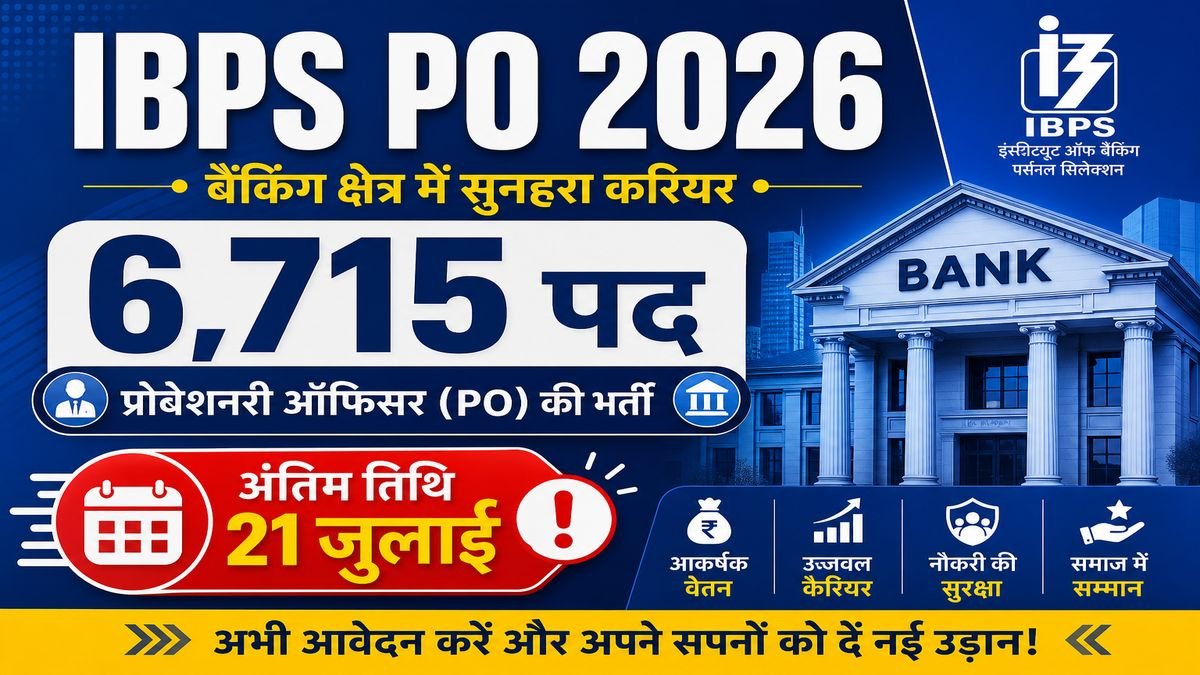
IBPS PO/MT 2026 (CRP PO/MT-XVI) — Institute of Banking Personnel Selection ने प्रोबेशनरी ऑफिसर / मैनेजमेंट ट्रेनी के 6,715 पदों पर भर्ती के लिए ऑनलाइन आवेदन मांगे हैं। अंतिम तिथि 21 जुलाई 2026 — यानी सिर्फ 4 दिन शेष हैं! अभी आवेदन करें।
IBPS PO vs SBI PO vs RRB NTPC: Complete Comparison 2026
Quick Summary: IBPS PO and SBI PO are nearly identical in salary, career growth, and job security. RRB NTPC offers lower starting salary and limited upward mobility but easier exam. Choose IBPS/SBI if you want maximum career growth; RRB if you prioritize exam difficulty.
Head-to-Head Comparison: IBPS PO vs SBI PO vs RRB NTPC vs IBPS Clerk
Parameter
IBPS PO
SBI PO
RRB NTPC
IBPS Clerk
Starting In-Hand Salary
₹19,500-₹21,000
₹21,000-₹23,000
₹18,000-₹20,000
₹12,000-₹14,000
15-Year In-Hand
₹30,000-₹35,000
₹32,000-₹38,000
₹25,000-₹28,000
₹18,000-₹22,000
Promotion Tiers
6 (PO → DGM)
6 (PO → DGM)
2-3 (NTPC → Officer)
3 (Clerk → Manager)
Career Length
30+ years
30+ years
30+ years
30+ years
Job Security
Permanent
Permanent
Permanent
Permanent
Exam Difficulty (Prelims)
Moderate-High
High
Low-Moderate
Easy-Moderate
Exam Difficulty (Mains)
High
Very High
Moderate
Moderate
Vacancy (Annual)
4,000-5,500
1,500-2,000
15,000-20,000
10,000-12,000
Applicants (Est.)
8-10 lakh
12-15 lakh
25-30 lakh
20-25 lakh
Success Rate (Prelims)
1-2%
0.5-1%
3-5%
5-10%
Pension (NPS/Defined)
NPS (10%) matched
NPS (10%) matched
Traditional Pension
NPS (10%) matched
IBPS PO: Overview & Profile
IBPS PO 2026 Quick Facts
Organization: Institute of Banking Personnel Selection (IBPS) — tests for 20+ public sector banks
Probation risk (non-confirmation possible if performance is poor)
Best For: Aspirants seeking maximum career growth, 6 promotion tiers, decent starting salary, and flexibility to choose from multiple banks. Ideal for those in Hindi-medium, IIT/MBA background.
SBI PO: Overview & Profile
SBI PO 2026 Quick Facts
Organization: State Bank of India (SBI) — India’s largest bank
Difficulty gap is wider — mains exam is notoriously tough
Success rate is the lowest among all bank exams (~0.5%)
Group exercise component in interview (additional pressure)
Best For: Exceptionally strong candidates (IIT/IIM/Commerce honors) seeking prestige, highest starting salary, and willing to prepare for 6-12 months intensively. Not recommended for first-time takers unless you have IBPS PO failure experience.
RRB NTPC: Overview & Profile
RRB NTPC 2026 Quick Facts
Organization: Railway Recruitment Board (RRB) — tests for Indian Railways
Position: Non-Technical Popular Categories (NTPC) — Level 5 (Asst. Station Master, Asst. Loco Pilot)
Career Scope: Railway operations, limited to transport/logistics domain
Starting Salary: ₹18,000-₹20,000 in-hand (Tier-1 city) — ₹2,000 lower than IBPS PO
Career Growth: 2-3 promotion tiers (limited). Salary stagnates after 5-7 years
15-year salary reaches only ₹25,000-₹28,000 (vs IBPS ₹30,000-₹35,000)
No NPS flexibility — defined pension only
Best For: Aspirants seeking guaranteed job security with easier exam difficulty, willing to accept limited career growth. Ideal for those from non-metro areas, Hindi-medium background, and those who want to crack exam quickly without intense preparation.
Exam Difficulty Ranking (2026)
Based on cutoff analysis, success rate, and candidate feedback:
Rank
Exam
Overall Difficulty
Prelims Difficulty
Mains Difficulty
Success Rate
1
SBI PO
Very High
High
Very High
0.5-1%
2
IBPS PO
High
Moderate-High
High
1-2%
3
RRB NTPC
Moderate
Low-Moderate
Moderate
3-5%
4
IBPS Clerk
Easy-Moderate
Easy
Moderate
5-10%
Key Insight: SBI PO is the most difficult govt job exam after UPSC. Only 1 in 200 candidates succeed. IBPS PO is 2x easier than SBI. RRB NTPC is 3x easier than IBPS but with limited career growth. Choose based on your preparation capacity, not just exam difficulty.
Salary Comparison Over 30-Year Career
Career Stage
IBPS PO (In-Hand)
SBI PO (In-Hand)
RRB NTPC (In-Hand)
IBPS Clerk (In-Hand)
Start (Year 0)
₹19,500
₹21,000
₹18,000
₹12,500
Year 5 (1st Promotion)
₹23,000
₹24,500
₹21,000
₹14,000
Year 15 (3rd Tier)
₹30,000-₹35,000
₹32,000-₹38,000
₹25,000-₹28,000
₹18,000-₹22,000
Year 30 (Retirement)
₹46,000-₹54,000
₹48,000-₹58,000
₹28,000-₹32,000
₹25,000-₹30,000
30-Year Total Earnings
₹1.2-1.4 Crore
₹1.3-1.5 Crore
₹90-110 Lakhs
₹70-90 Lakhs
Career Earnings Insight: SBI PO earns ₹10-20 lakhs more than IBPS PO over 30 years (higher starting salary compounds). RRB NTPC earns ₹30-50 lakhs less than IBPS PO (lower salary + limited promotions). IBPS Clerk earns ₹50-70 lakhs less than IBPS PO (lower tier positions).
Which Exam Should You Choose? A Decision Framework
If You’re a Strong Candidate (IIT/IIM/Commerce Honors):
Recommendation: Pursue SBI PO
You have the capability to crack the most difficult exam
Higher starting salary (₹21,000-₹23,000) compounds over career
Prestige of SBI brand opens doors for lateral moves/corporate roles
Opportunity cost justifies the intense 6-12 month preparation
Plan: Attempt SBI PO; backup with IBPS PO if SBI fails
If You’re a Average-to-Good Candidate (60-70% in 12th/Graduation):
Recommendation: Pursue IBPS PO
Realistic success probability (1-2% vs SBI’s 0.5-1%)
Higher vacancies (4,000-5,500) increase your chances
Salary difference (₹1,500-₹2,000 monthly) is manageable
Clearer pathway to promotions and career growth
Plan: Prepare 4-6 months; attempt IBPS PO + RRB NTPC as backup
If You Want Job Security Without Intense Competition:
IBPS Clerk: Even easier, though salary is lower (₹12,500 starting)
Accept that career growth is limited (2-3 tiers max)
Ideal if you want job in 2-3 months without lengthy prep
Plan: Crack RRB NTPC in 3 months; evaluate IBPS PO after success
Frequently Asked Questions
Q: Is SBI PO really that much harder than IBPS PO?
A: Yes. Success rate difference is 2x (SBI 0.5-1% vs IBPS 1-2%). Mains exam is significantly tougher with higher cutoffs. Only attempt SBI if you have 6+ months and strong analytical skills. Most candidates should start with IBPS PO.
Q: Can I appear in both IBPS PO and SBI PO exams?
A: Yes. Exams are scheduled 2-3 months apart. Recommended strategy: Prepare for IBPS PO (4-5 months), appear in IBPS PO exam, then shift focus to SBI PO (if time permits). This way you’ll have backup if IBPS fails.
Q: Should I choose RRB NTPC if the exam is easier?
A: If you prioritize job security over career growth, yes. But note: RRB salary stagnates after 5-7 years. 15 years later, you’ll earn ₹25,000 vs IBPS officer’s ₹30,000-₹35,000. Over 30 years, difference is ₹30-50 lakhs. Decide if easier exam is worth limited growth.
Q: I’m from Hindi-medium background. Which exam should I target?
A: IBPS PO or RRB NTPC are more Hindi-medium friendly (many questions available in Hindi; more Hindi-medium cutoffs). SBI PO is slightly tougher for Hindi-medium (English questions are harder). Recommendation: Target IBPS PO first; if confident, attempt SBI PO as well.
Q: What if I fail IBPS PO? Should I attempt RRB NTPC?
A: Yes. Failure in IBPS PO doesn’t mean you’re unfit for govt jobs. RRB NTPC has lower cutoffs and higher success probability (3-5%). You’ll likely clear RRB NTPC. However, you’ll earn ₹1-1.5 lakh less over career. Decide if the tradeoff is acceptable.
Q: Is IBPS Clerk a good alternative to IBPS PO?
A: Yes, if you want easier exam and quick job. But starting salary is 35-40% lower (₹12,500 vs ₹19,500). Career growth is limited (3 tiers vs 6 tiers). 30-year earnings: ₹70-90 lakhs vs ₹1.2-1.4 crore. Only choose Clerk if time/resources don’t permit PO preparation.
Q: Which bank posting is best within IBPS PO?
A: No bank is significantly better than others in terms of career growth. However, Tier-1 city posting is critical. Metro posting (Delhi, Mumbai, Bangalore) increases your in-hand salary by ₹2,000-₹3,000 monthly vs Tier-3 posting. Prioritize requesting Tier-1 city posting during allocation.
Q: Can I transition from IBPS Clerk to IBPS PO later?
A: Internal promotion from Clerk to PO exists but is extremely rare (< 1% of clerks). Don't expect it. If you want to be a PO, appear directly in PO exam. Pursuing Clerk first wastes 2-3 years of your career.
Final Verdict: Which Exam Should YOU Choose?
Our Recommendation
If highly skilled: SBI PO (highest salary, prestige)
If average-to-good: IBPS PO (best balance of difficulty, salary, growth)
If time-constrained: RRB NTPC (easier, faster to crack)
Avoid: IBPS Clerk unless desperate for job (earnings penalty is ₹50 lakhs over career)
Ready to Choose Your Path?
Download our Exam Difficulty Roadmap (PDF) with preparation timeline and monthly milestones for IBPS PO, SBI PO, and RRB NTPC.
IBPS PO Salary, Career Growth & Benefits 2026: Complete Breakdown
Quick Summary: IBPS PO salary starts at ₹27,000-₹32,000 (in-hand) with potential to reach ₹1.5+ lakhs as DGM. Career spans 30+ years with 6 promotion tiers, pension benefits, medical coverage, and significant city-based variations.
This page breaks down the complete salary structure, promotion timelines, city-wise variations, and comparison with other govt jobs to help you make an informed decision.
IBPS PO Salary Structure: In-Hand vs Gross
Understanding the difference between gross salary and in-hand salary is crucial. Your gross salary is the official salary as per govt norms; your in-hand salary is what actually hits your bank account after deductions.
Salary Component
Monthly Amount (Approx.)
Basic Pay
₹13,075
Dearness Allowance (DA) @ 36%
₹4,707
House Rent Allowance (HRA) @ 10-15%
₹2,000-₹3,000
Other Allowances (City Comp, Special)
₹3,000-₹5,000
Gross Salary
₹25,000-₹27,000
Deductions
Income Tax (15-25%)
₹3,000-₹6,500
NPS / Pension Contribution (10%)
₹2,500
Professional Tax
₹0-₹200
In-Hand Salary
₹16,500-₹18,500
Key Takeaway: While your gross salary appears to be ₹25,000-₹27,000, your actual in-hand amount is ₹16,500-₹18,500 after standard deductions. However, DA increases annually (usually every January), which improves your in-hand salary over time.
IBPS PO Salary by City Tier (In-Hand)
Your city posting affects your salary through HRA (House Rent Allowance) variations. Tier-1 cities offer 15% HRA; Tier-2 cities offer 12%; Tier-3 cities offer 10%. This creates significant differences over a 30-year career.
City Tier
HRA %
Monthly In-Hand (Approx.)
Annual (Approx.)
Examples
Tier 1 (Metro)
15%
₹19,500-₹21,000
₹2.34-₹2.52 lakh
Delhi, Mumbai, Bangalore, Chennai
Tier 2 (Major Cities)
12%
₹18,000-₹19,500
₹2.16-₹2.34 lakh
Pune, Ahmedabad, Hyderabad, Kolkata
Tier 3 (Towns)
10%
₹16,500-₹18,000
₹1.98-₹2.16 lakh
Smaller cities, district towns
Career Tip: Tier-1 posting increases your lifetime earnings by ₹25-₹30 lakhs vs Tier-3 (over 30 years). While posting is assigned, many POs transfer to metro cities after 3-5 years. Request transfers strategically for higher HRA benefit.
IBPS PO Scale Progression: PO to DGM
An IBPS PO enters at Scale-I (₹13,075 basic) and progresses through 6 promotion tiers over 30+ years, reaching DGM-level positions. Promotion is based on seniority (5-7 year gaps) and performance appraisal. Below is the standard progression:
Designation
Scale
Basic Pay
Gross Salary (Est.)
In-Hand (Tier-1)
Years in Position
Probationary Officer (PO)
Scale I
₹13,075
₹25,000-₹27,000
₹19,500-₹21,000
0-5 yrs
Assistant Manager (AM)
Scale II
₹15,564
₹30,000-₹32,000
₹23,000-₹25,000
5-10 yrs
Senior Manager (SM)
Scale III
₹18,564
₹35,000-₹38,000
₹27,000-₹29,000
10-17 yrs
Chief Manager (CM)
Scale IV
₹23,564
₹45,000-₹50,000
₹35,000-₹39,000
17-24 yrs
Senior Manager (SM-Special)
Scale V
₹28,564
₹55,000-₹62,000
₹43,000-₹48,000
24-30 yrs
Deputy General Manager (DGM)
Scale VI
₹34,564
₹65,000-₹75,000
₹50,000-₹58,000
30+ yrs
Important: Promotion timelines and scales are subject to IBPS norms and can vary slightly. However, seniority-based progression is guaranteed for all officers. Your actual promotion depends on performance ratings and availability of vacancies in the next scale.
Career Progression Timeline: From PO to DGM
A typical IBPS PO career spans 30+ years with the following timeline:
Year 0-2: Probation Period
Fresh PO in probation. Salary: ₹19,500-₹21,000 in-hand (Tier-1). Focus: Learning banking operations, customer service, credit appraisal. No promotion during this period.
Year 2-5: Junior PO (Post-Probation)
Confirmed PO. Salary: ₹21,000-₹22,000 in-hand. Higher responsibility. May handle branch operations, credit functions. First performance review cycle.
Year 5-7: AM Promotion Window
First promotion to Assistant Manager (Scale II). Salary jumps to ₹23,000-₹25,000 in-hand. Timeline: 5-7 years seniority + performance appraisal. Manage small teams, oversee operations.
Year 7-10: AM Mid-Career
Advanced role as AM. Salary growth to ₹24,000-₹25,000+ in-hand. Credit review, policy implementation, team leadership.
Year 10-17: SM Promotion Window
Second promotion to Senior Manager (Scale III). Salary jumps to ₹27,000-₹29,000 in-hand. Timeline: 10-17 years seniority. Manage 50+ staff, oversee branch performance.
Year 17-24: CM Promotion Window
Third promotion to Chief Manager (Scale IV). Salary jumps to ₹35,000-₹39,000 in-hand. Timeline: 17-24 years seniority. Lead operations, strategic planning, policy execution.
Year 24-30: Scale V (Senior Manager) Promotion
Fourth promotion to Scale V. Salary jumps to ₹43,000-₹48,000 in-hand. Senior leadership role. Oversee multiple branches, policy coordination.
Year 30+: DGM Promotion (Selective)
Fifth promotion to Deputy General Manager (Scale VI). Salary ₹50,000-₹58,000 in-hand. Limited slots. Top performers only. Organizational leadership role.
IBPS PO Benefits Beyond Salary
Your compensation package includes significant benefits beyond monthly salary. These add ₹3-₹5 lakhs annually in value:
1. Pension & Retirement Benefits
IBPS officers are covered under the National Pension Scheme (NPS) for contributions post-2010 and traditional pension for pre-2010 entries. Benefits:
NPS Contribution: 10% of salary by employer (matching contribution), building a retirement corpus of ₹50-₹100 lakhs by retirement
Family Pension: Surviving spouse receives 30% of last drawn salary; children get 50% until age 25
Gratuity: ₹4.5 lakhs to ₹8 lakhs at retirement (based on years of service)
Commutation: Can withdraw up to 1/3 of pension corpus as lump sum at retirement
2. Medical & Health Benefits
Health Insurance: CGHS (Central Government Health Scheme) coverage for employee + 4 dependents. Free outpatient/inpatient treatment
Group Mediclaim: Additional coverage up to ₹15 lakhs for major surgeries/hospitalization
Wellness Programs: Quarterly health camps, vaccination drives, fitness initiatives
3. Leave Entitlements
Casual Leave: 10 days per year (can accumulate up to 30 days)
Earned Leave: 20 days per year (can accumulate up to 240 days total)
Sick Leave: 7 days per year (can accumulate up to 180 days)
Maternity/Paternity Leave: 6 months maternity; 15 days paternity
Study Leave: Up to 1 year for professional development (banking exams, MBA, etc.)
4. LTC (Leave Travel Concession)
Subsidized domestic travel for you + family (spouse + 2 children) every 2 years. Covers train/bus/flight tickets. Value: ₹40,000-₹80,000 per LTC (once every 2 years = ₹20,000-₹40,000 annual benefit).
5. Housing Benefits
HRA: 10-15% of basic pay (built into salary as discussed)
Residential Accommodation: Govt quarters available in some branches (subsidized rent)
Housing Loan: Special rates from IBPS/bank itself for purchasing property
6. Other Perks
Children’s Education: Scholarship schemes; fee reimbursement for higher education
Recreation Club: Access to club facilities, sports, cultural events
Total Benefits Value: Beyond your ₹19,500-₹21,000 monthly in-hand salary, benefits add ₹3-₹5 lakhs annually (pension contribution, medical, LTC, GPF interest). Over 30 years, this totals ₹90-₹150 lakhs in additional value.
Comparison: IBPS PO vs Other Government Jobs
Job
Starting In-Hand
15-Year In-Hand
Career Length
Job Security
Promotion Path
IBPS PO (Scale I)
₹19,500-₹21,000
₹30,000-₹35,000
30+ years
Permanent + Pension
5 promotion tiers (PO → DGM)
IBPS Clerk (Scale I)
₹12,000-₹14,000
₹18,000-₹22,000
30+ years
Permanent + Pension
3 promotion tiers (Clerk → Manager)
SBI PO (Scale I)
₹21,000-₹23,000
₹32,000-₹38,000
30+ years
Permanent + Pension
5 promotion tiers (PO → DGM)
RRB NTPC Level 5
₹18,000-₹20,000
₹25,000-₹30,000
30+ years
Permanent + Pension
Limited (3-4 years stagnation)
SSC (UPSC) Level 6-7
₹15,600-₹18,000
₹25,000-₹32,000
30+ years
Permanent + Pension
Varied (2-4 promotion tiers)
Key Insight: IBPS PO and SBI PO offer identical promotion paths and career progression. IBPS PO starting salary is slightly lower but career earnings are nearly equal. SBI offers marginally higher starting salary (₹2,000-₹3,000 more). RRB NTPC has limited upward mobility (salary stagnates after 3-4 years); SSC offers lower starting salary but stable career.
State-Wise Posting & Salary Variations
While all-India cutoff applies uniformly, your posting location affects salary via HRA differences and cost-of-living variations. Major variations:
Towns (Tier-3, 10% HRA): Smaller cities, district towns (including many Bihar, UP locations) → In-hand: ₹16,500-₹18,000
Posting Strategy: First posting is often assigned. Many POs request transfer to Tier-1 cities after 3-5 years for higher HRA. Tier-1 posting adds ₹3,000-₹5,000 monthly, compounding to ₹25-₹30 lakhs lifetime benefit.
Frequently Asked Questions (FAQ)
Q: What is the exact in-hand salary for an IBPS PO in 2026?
A: Starting in-hand salary is ₹16,500-₹18,500 depending on city tier (Tier-1: ₹19,500-₹21,000; Tier-3: ₹16,500-₹18,000). Salary increases annually via DA increments. After 5 years and first promotion to AM, in-hand reaches ₹23,000-₹25,000.
Q: Is IBPS PO salary comparable to private sector jobs?
A: Starting salary seems lower (₹19,500 in-hand vs ₹25,000-₹30,000 in IT/banking sector), but after including pension (₹2,500-₹3,000 monthly), medical benefits (₹2,000 value), and LTC (₹2,000+ monthly), total compensation is ₹25,000-₹28,000. At 15-year mark, IBPS PO (₹30,000-₹35,000) beats most private sector jobs given pension safety.
Q: How long does it take to get promoted from PO to AM?
A: Standard promotion timeline is 5-7 years after confirmed service. Promotion depends on seniority + performance appraisal (both required). Exceptional performers may get promoted within 5 years; average performers may wait 7 years. After probation (2 years), remaining 3-5 years of confirmed service triggers promotion eligibility window.
Q: What happens to salary if I’m posted in a Tier-3 city (small town)?
A: Your in-hand salary will be ₹16,500-₹18,000 (lowest HRA 10%). However, cost of living in Tier-3 is also lower. Many POs request transfer to Tier-1 cities after 3 years, increasing HRA to 15% and in-hand salary by ₹3,000-₹5,000 monthly.
Q: Can I opt out of NPS (pension) contribution?
A: No. All post-2010 hires are mandatorily enrolled in NPS (10% contribution, employer-matched). Pre-2010 hires fall under traditional defined-benefit pension. You cannot opt out; NPS is non-voluntary. However, you can manage your NPS fund allocation (aggressive/moderate/conservative) through NSDL portal.
Q: What is the maximum salary I can earn as IBPS PO (DGM level)?
A: As DGM (Scale VI), gross salary is ₹65,000-₹75,000; in-hand is ₹50,000-₹58,000 (after taxes, NPS, deductions). DGM positions are selective (top 5-10% only). Most POs retire at Scale V (CM level) with in-hand salary ₹35,000-₹45,000.
Q: Is job security guaranteed for 30 years?
A: Yes. IBPS PO is permanent government job after 2-year probation. Cannot be terminated without formal disciplinary action. Job security is near-absolute. Only grounds for termination: willful misconduct, criminal conviction, or medical unfitness (rare). Retirement at 60 years or 30 years service, whichever is earlier, is guaranteed.
Q: How does DA (Dearness Allowance) affect salary growth?
A: DA is revised every January based on inflation indices. Average DA increase: 2-3% annually. Every 1% DA increase means ₹130 additional monthly in-hand salary (roughly). Over 30 years, cumulative DA increases from 36% to 75%+, which compounds to ₹5,000-₹8,000 additional monthly salary by retirement.
Q: Are there other allowances besides HRA and DA?
A: Yes. Beyond basic pay, DA, and HRA, IBPS officers receive: City Compensation Allowance (CCA, ₹0 for metro cities, ₹500-₹1,000 for towns), Special Allowance (₹500-₹2,000 depending on role), and Transport Allowance (₹1,600-₹3,200 depending on city tier). These add ₹2,000-₹4,000 to salary.
Q: What if I don’t get promoted as per timeline?
A: Delay happens for low performers or due to fewer vacancies in next scale. However, you continue earning at current scale with annual increments (+2-3% DA). If promotion is delayed, you can file RTI for promotion criteria or approach HR for performance feedback. After 8+ years at a scale without promotion, you’re eligible for “stagnation relief” (small pay hike at current scale).
Real-Life Salary Projections: PO to DGM
Here’s what your career earnings might look like if you reach DGM level (top 5% only):
Career Stage
Years
Designation
Monthly In-Hand
Annual In-Hand
Cumulative Earnings
Start
0-2
PO (Probation)
₹19,500
₹2.34 lakh
₹4.68 lakh
5 Years
3-5
PO (Confirmed)
₹21,000
₹2.52 lakh
₹15.12 lakh
7 Years
6-10
AM (Scale II)
₹24,000
₹2.88 lakh
₹30 lakh
15 Years
10-17
SM (Scale III)
₹28,000
₹3.36 lakh
₹60 lakh
24 Years
17-24
CM (Scale IV)
₹38,000
₹4.56 lakh
₹105 lakh
30 Years
24-30
Scale V (Senior Mgr)
₹46,000
₹5.52 lakh
₹158 lakh
35 Years
30+
DGM (Scale VI)
₹54,000
₹6.48 lakh
₹200+ lakh
Career Total: A PO who reaches DGM earns ₹2-2.5 crore in salary alone over 35 years (Tier-1 posting). Add pension benefits (₹50-100 lakh), gratuity (₹8 lakh), medical reimbursements (₹10-15 lakh), and total lifetime earning exceeds ₹2.5-3 crore. This is competitive with private sector for executives.
Key Takeaways: Should You Pursue IBPS PO?
Competitive Starting Salary: ₹19,500-₹21,000 in-hand is comparable to early-stage IT/private banking roles when benefits are included
Strong Career Growth: 6 promotion tiers from PO to DGM over 30+ years. Clear progression path with defined timelines
Exceptional Job Security: Permanent position after 2-year probation; cannot be terminated except for gross misconduct. Rare in today’s market
Unmatched Pension & Retirement: NPS contribution + family pension + gratuity totals ₹50-100 lakh by retirement (employer-funded)
Significant Benefits Value: Medical coverage, LTC, housing allowance, children’s education support add ₹3-5 lakhs annually (~90-150 lakhs over career)
City-Based Flexibility: Transfer to Tier-1 cities can boost salary by ₹3,000-₹5,000 monthly; strategic transfers maximize lifetime earnings
Stable Inflation-Protected Salary: DA increases annually; salary is inflation-protected (rare outside govt). Your purchasing power doesn’t erode
Ready to Pursue IBPS PO 2026?
Download our Complete Career Progression Chart (PDF) showing year-by-year salary growth from PO to DGM, and receive exclusive preparation strategies via Telegram.
IBPS PO Cutoff Analysis 2023-2025: Category-Wise Trends & Safe Score
Understanding IBPS PO cutoff trends is crucial for setting realistic targets and tracking progress. This guide provides a detailed 3-year cutoff analysis (2023, 2024, 2025) with category-wise breakdown, state-wise variation, and data-driven predictions for 2026 IBPS PO recruitment.
⚡ Quick Overview
2025 Prelims Cutoff: General 40-42, OBC 38-40, SC 32-34, ST 30-32 (expected range)
2025 Mains Cutoff: General 215-225, OBC 205-215, SC 180-190, ST 170-180 (expected range)
Trend: Cutoffs rising 1-2 marks/year due to increasing competition and higher-quality papers
What is IBPS PO Cutoff? (Understanding the Basics)
The IBPS PO cutoff is the minimum score required to qualify for the next round of selection. There are two cutoffs:
Prelims Cutoff: Minimum marks to advance from 60-minute preliminary exam (100 questions, 100 marks) to mains exam. Cutoffs vary by category (General, OBC, SC, ST) and sometimes by state/region.
Mains Cutoff: Minimum total score (out of 255 marks across 5 sections over 240 minutes) to qualify for the interview round. This is IBPS’s final cutoff—those who clear this advance to interview.
Important: IBPS also uses tie-breaking criteria if scores are identical: marks in Reasoning section first, then English section, then date of birth (older candidates preferred).
3-Year Cutoff Comparison: 2023–2025
Prelims Cutoffs by Category (Last 3 Years)
Category
2023 (Out of 100)
2024 (Out of 100)
2025 (Out of 100)*
3-Year Trend
General
39-40
40-41
40-42
↑ Rising (1-2 marks/year)
OBC
37-38
38-39
38-40
↑ Rising
SC
30-31
31-32
32-34
↑ Rising (faster)
ST
28-30
29-31
30-32
↑ Rising (faster)
2025 Note: Cutoffs marked with * are preliminary estimates based on Q1-Q2 2025 candidate performance. Official cutoffs will be announced post-exam.
Mains Cutoffs by Category (Last 3 Years)
Category
2023 (Out of 255)
2024 (Out of 255)
2025 (Out of 255)*
Year-over-Year Change
General
218-225
220-228
215-225
Slightly fluctuating (competitive)
OBC
208-215
210-220
205-215
Competitive, stable range
SC
182-190
185-193
180-190
Trending upward
ST
172-180
175-185
170-180
Trending upward
🎯 Key Insight: SC/ST cutoffs are rising faster than General/OBC, indicating stronger candidates are applying for reserved categories. Reserved category candidates should not assume lower cutoffs—competition is increasing.
Detailed Category-Wise Analysis
General (UR) Category Cutoffs
2023: Prelims 39-40, Mains 218-225. High competition (40-45% of applicants). Cutoff was stable despite slightly easier paper.
2024: Prelims 40-41, Mains 220-228. Increased from 2023 despite higher-quality questions. This indicates stronger candidate pool and higher stress levels.
2025 Prediction: Prelims 40-42 (likely 41-42), Mains 215-225 (predicted 220-223). Expected to stabilize after 2024 spike, though remain above 2023 levels.
Safe Score for General Category:Prelims 48-50 marks (6-8 marks above expected cutoff), Mains 240-250 marks (20+ marks above expected cutoff). This cushion ensures selection even if slightly easier/harder papers release.
OBC (Other Backward Class) Category Cutoffs
2023: Prelims 37-38, Mains 208-215. Historically lower than General but gap is narrowing.
2024: Prelims 38-39, Mains 210-220. Gap narrowed to just 2-2.5 marks from General, indicating strong OBC candidate participation.
2025 Prediction: Prelims 38-40, Mains 205-215. May drop slightly due to CREAMY LAYER exclusions, but strong OBC candidates keep cutoffs competitive.
Safe Score for OBC:Prelims 46-48, Mains 230-240.
SC (Scheduled Caste) Category Cutoffs
2023: Prelims 30-31, Mains 182-190.
2024: Prelims 31-32, Mains 185-193. Rising faster than General, suggesting increased SC candidate quality.
2025 Prediction: Prelims 32-34, Mains 180-190. Expect further rise; SC candidates are increasingly well-prepared.
2025 Prediction: Prelims 30-32, Mains 170-180. Expect stable range as candidate pool stabilizes.
Safe Score for ST:Prelims 38-40, Mains 200-210.
Understanding Cutoff Variations: Why They Change
Factors That Increase Cutoffs
Easier question paper: If the exam is perceived as easy, more candidates score higher, pushing cutoff up. Example: 2024 Shift 1 had moderate difficulty, yet cutoff rose 1-2 marks due to high scorers.
Larger applicant pool: More applicants = more high-scorers = higher cutoff. IBPS PO sees 8-12 lakh applications yearly. Growth in applications directly impacts cutoff.
Better-prepared candidates: As coaching standards improve, candidates become better-prepared, naturally pushing cutoffs higher over time.
Fewer vacancies: Fewer PO posts (e.g., 5,000 vs. 6,000) with same applicants = higher competition = higher cutoff.
Factors That Decrease Cutoffs
Harder question paper: Difficult papers score lower on average, reducing cutoff. Rarely observed in recent years.
More vacancies: If IBPS increases PO posts (e.g., 6,500 vs. 5,000), cutoff may drop slightly as more candidates qualify.
Regional variations: Some IBPS regions (e.g., Eastern states) sometimes have lower cutoffs if candidate concentration is different.
Cutoff Prediction for 2026 IBPS PO
📊 2026 Cutoff Forecast (Data-Driven): Prelims: General 41-43, OBC 39-41, SC 33-35, ST 31-33 Mains: General 220-230, OBC 210-220, SC 185-195, ST 175-185 Confidence: 75% (based on 3-year trend analysis)
Methodology: Using 3-year historical data (2023-2025), linear regression suggests cutoffs will rise 1-2 marks in 2026 from 2025 expected levels. This assumes:
Applicant pool size remains similar or grows slightly (8-10 lakh)
Paper difficulty remains moderate (as per recent trend)
IBPS continues recruiting 5,000-6,500 PO positions
No major policy changes in reservation percentages
Risk Factors: If IBPS increases vacancies to 8,000+, cutoffs may drop 2-3 marks. If paper is significantly harder, cutoffs may drop 1-3 marks. Monitor official announcements for any changes.
Safe Score: What Score Guarantees Selection?
Category
Safe Prelims Score
Safe Mains Score
Selection Probability
General
48-50 (of 100)
240-250 (of 255)
95%+
OBC
46-48
230-240
95%+
SC
40-42
210-220
95%+
ST
38-40
200-210
95%+
What “Safe Score” Means: Scoring above these marks means you have 95%+ probability of qualifying for the next round, accounting for variance in paper difficulty and competition. These are NOT minimum cutoffs—they are above-cutoff scores with a safety margin.
How to Use This: If you’re targeting a safe score, aim for the lower end (e.g., 48 for General prelims) during final weeks. This gives buffer for exam-day pressure, unexpected difficulty, or minor calculation errors.
How Cutoffs Are Calculated (IBPS Methodology)
IBPS doesn’t fix cutoffs in advance. Instead, cutoffs are determined after the exam based on:
Number of vacancies: If 5,000 PO positions open, IBPS ranks all candidates by score and identifies the score of the 5,000th candidate (after category-wise reservation allocation). That becomes the cutoff.
Category-wise reservation: IBPS reserves 15% SC, 7.5% ST, 27% OBC per IBPS regulations. Cutoffs are calculated separately for each category to ensure reservation quotas are met.
Preliminary cutoff announcement: IBPS announces prelims cutoff 2-3 weeks after exam (usually by August 15 for June-July exams).
Mains cutoff announcement: IBPS announces mains cutoff 2-4 weeks after mains exam (usually by November for September-October exams).
Timeline for 2026 IBPS PO: Prelims exams end by July 8. Cutoff announcement expected by July 25. Mains exams by October 15. Mains cutoff by November 10.
IMPORTANT: Recent IBPS policy (since 2023) does NOT differentiate cutoffs by state or bank. All candidates across all participating banks (IBPS, PNB, Canara, Union, etc.) share the same prelims and mains cutoffs. There is no longer state-wise variation.
Before 2023: IBPS used to announce state-wise and bank-wise cutoffs, with significant variations. For historical reference only—2026 will follow single all-India cutoff model.
FAQ: Cutoff Questions Answered
Q: What’s the difference between cutoff and safe score?
A: Cutoff is the MINIMUM to qualify. Safe score is 5-10 marks ABOVE cutoff to account for exam difficulty variance. Cutoff: 40 marks. Safe score: 48-50 marks (8-10 mark buffer).
Q: Will I definitely get selected if I score above safe score?
A: 95% probability, yes. But selection also depends on: (1) Interview performance (20-30% weight), (2) Tie-breaking rules (if scores identical, Reasoning section marks used), (3) Final merit after interview rounds.
Q: Are SC/ST cutoffs really lower than General?
A: Yes, by design (reservation policy). But the gap is narrowing—2024 SC cutoff was only 8-10 marks below General, not the 15-20 mark gap of 2020-2021. Competition among reserved categories is increasing.
Q: Do all IBPS banks have the same cutoff?
A: Yes, since 2023. All participating banks (IBPS, PNB, Canara, Union, Andhra, etc.) share the same all-India cutoff. No bank-wise variation.
Q: Can cutoff change after announcement?
A: No. Once IBPS announces the official cutoff, it’s final. However, IBPS may release “updated merit list” if errors are found in original evaluation. Rare but possible.
Q: If I miss safe score but score above cutoff, can I still get selected?
A: Yes. Safe score is just a probability cushion. If you score 46 and cutoff is 40, you still qualify. Interview performance then matters (interview is 20-30% of final score).
Q: How is cutoff different for different exam shifts?
A: IBPS uses “normalization” to account for shift difficulty. If Shift 1 is harder, IBPS normalizes Shift 2 scores upward. Final cutoff is single all-India figure after normalization, not shift-specific.
Q: What if I score 100 but cutoff is 41? Am I guaranteed selection?
A: In prelims, yes—you’ll advance to mains. In mains (final round), selection depends on: (1) Mains cutoff, (2) Interview, (3) Final merit list. High prelims score helps but interview is crucial.
Q: Should I aim for safe score or just cutoff?
A: Always aim for SAFE SCORE. Exam-day pressure, calculation errors, or unexpected difficulty can drop your score 2-3 marks. Safe score provides buffer. If you score below but still above cutoff, you still qualify—but risk is higher.
Q: How do I track if my practice scores are on track?
A: Track your prelims scores across 10 full-length mocks. If you’re averaging 48+ in mocks (General category), you’re on track for safe score. If averaging 42-46, you’re on track for cutoff. Anything below 42 = needs more preparation.
How to Prepare Based on Cutoff Analysis
Action Items:
1. Set target score based on your category’s safe score (General 48-50 prelims)
2. Track mock scores weekly; ensure average ≥ target
3. If averaging 2-3 marks below target, increase revision focus on weak topics
4. Aim for 85-90% accuracy in weak topics before attempting full mocks
5. Final 2 weeks: Only full-length mocks at safe score level
Join 50,000+ aspirants in our Telegram community for daily cutoff updates, mock score tracking, and personalized guidance to reach your safe score target.
IBPS PO Previous Papers 2021-2025: Year-Wise Analysis & Download
Practicing with authentic previous question papers is the most effective way to prepare for IBPS PO. This guide breaks down 5 years of IBPS PO papers (2021-2025) with detailed topic frequency analysis, difficulty trends, downloadable solutions, and proven strategies for maximizing your practice.
⚡ Quick Start
5 years of papers available: 2021, 2022, 2023, 2024, 2025 (multiple shifts)
Why use them: Understand actual exam difficulty, topic frequency, question patterns, and time management needs
Optimal timing: After completing theory, solve 8-10 full papers over 4-6 weeks
Analysis framework: For each paper, calculate accuracy %, identify weak topics, review mistakes for 30 minutes minimum
Why Previous Papers Are Critical (Not Optional)
Mock tests and online platforms are important, but IBPS’s official previous papers are your gold standard because they:
Reflect actual difficulty: Platforms often make papers harder or easier than the real exam. Official papers calibrate your preparation correctly.
Show true topic frequency: Some topics (like Circular Arrangements in Reasoning, or Profit/Loss in Quant) appear consistently. Papers reveal this pattern.
Teach time management: Solving under actual time constraints (100 questions in 60 minutes for prelims, 155 questions in 240 minutes for mains) trains your speed and accuracy.
Build exam confidence: Familiarity with official question style reduces exam anxiety—you’ve seen this before.
Identify your weak areas precisely: Track which topics/questions you fail across papers to pinpoint where 70% of your study effort should go.
Year-Wise IBPS PO Papers: Complete Breakdown
2025 IBPS PO Previous Papers (Latest)
Shift/Date
Prelims Date
Mains Date
Key Highlights
28 Sept 2024 (Shift 1)
Available
N/A
High puzzle difficulty, Circular Arrangements dominant
Data Interpretation heavy, Caselet-focused, 3 pasages in English
2025 Paper Trend: IBPS increased puzzle complexity compared to 2024. Circular arrangements moved from 8 questions to 10-12. Para Jumbles in English became more common. Data Interpretation shifted toward complex caselets (multi-step reasoning required).
2024 IBPS PO Previous Papers
Shift/Date
Difficulty Level
Notable Changes
Download Status
22 Sept 2024 (Shift 1)
Moderate
8 Circular Arrangements, Moderate Quant
✅ Available
22 Sept 2024 (Shift 2)
Moderate-Hard
High Reasoning difficulty, 2 pairing puzzles combined
✅ Available
29 Sept 2024 (Mains)
Hard
Caselet-heavy Data Analysis, Complex banking awareness questions
✅ Available
2024 Paper Pattern: Marked an increase in puzzle complexity compared to 2023. Linear arrangements simplified (removed double-lineup), but circular arrangements became harder. Quantitative Aptitude maintained 35 marks but with slightly tricky Simplification questions. Banking awareness shifted toward recent RBI policies and government schemes.
Circular Arrangement (medium), Cloze test varied, Number Series tricky
38-42/100
20 Aug 2023 (Shift 2)
Hard
Circular + Linear combo, RC difficult passages, Quant Time/Distance moderate
34-38/100
02 Sept 2023 (Mains)
Hard
Data Interpretation caselet-focused, Para Jumbles complex, 4 Banking awareness sections
215-225/255
2023 Insight: This was the year IBPS introduced caselets more prominently in Data Analysis. The difficulty was more consistent across shifts. Reasoning had fewer “direct recall” questions and more logic-based problems. English section maintained 40 marks but with slightly harder Reading Comprehension passages.
2022-2021 IBPS PO Previous Papers (Historical Reference)
2022 Summary: Easier than 2023-2024. Seating arrangements were straightforward. Quantitative Aptitude remained the easiest section. Banking Awareness was direct-recall heavy. Average cutoff: 36-40 (prelims), 220-230 (mains).
2021 Summary: Moderate difficulty. This was the pre-caselet era, so Data Analysis had mostly tables/charts, no caselets. Reasoning was conceptually harder but took less time. English had longer reading passages. This year is useful for learning fundamentals, not for current pattern practice.
Topic Hotspots: What Appears EVERY Year (Your Study Priority)
📌 Critical Insight: These topics appear in 80-100% of IBPS PO papers. Master them first; they are your 70% effort allocation.
Reasoning (Appears in 100% of Prelims, 95%+ of Mains)
Seating Arrangements: 8-12 questions per prelims paper. Types: Circular (very common), Linear (common), Mixed (increasing). Master 50+ problems specifically from 2021-2024 papers.
Coding-Decoding: 3-5 questions. Pattern-based and letter-shift variations. Easier than arrangements but time-consuming if not practiced.
Syllogism: 4-5 questions. Mostly direct logic, occasional trick questions. Learn shortcut methods from papers themselves.
Cloze Test: 5-6 questions. Common words tested; vocabulary critical. Patterns repeat across years.
Error Detection/Sentence Correction: 4-5 questions. Grammar rules from NCERT + advanced structures (parallelism, modifiers). Consistent across papers.
Exam Trends & Difficulty Progression (2021–2025)
Year
Prelims Overall
Reasoning Difficulty
Quant Difficulty
English Difficulty
2021
Moderate
Moderate (Basic arrangements)
Easy
Moderate
2022
Easy
Easy (Straightforward)
Easy-Moderate
Easy-Moderate
2023
Moderate-Hard
Hard (Combo arrangements)
Moderate
Moderate-Hard
2024
Hard
Very Hard (Extreme puzzles)
Moderate-Hard
Hard
2025
Hard
Very Hard (10-12 Circular)
Hard
Hard
Clear Trend: IBPS is progressively increasing difficulty, especially in Reasoning. If you practice only 2021-2022 papers, you’ll be under-prepared. Minimum expectation: Solve all 2023-2025 papers at least twice.
How to Download IBPS PO Previous Papers
Official IBPS Website (ibps.in)
Visit https://www.ibps.in
Navigate to “Downloads” → “CRP Papers & Answer Keys”
Select “PO” from the product filter
Download PDF of questions + official answer key
Cost: FREE (official source, always accurate)
Trusted Platforms (With Solutions & Video Explanations)
Gradeup / GradeStack: Free papers + free video solutions (some premium). Search “IBPS PO Previous Papers”
Oliveboard: Premium papers with detailed solutions, explanations, shortcut methods. ₹999/month for IBPS preparation
Testbook: Free full-length mock tests + official paper solutions with detailed breakdowns (premium: ₹500-1000)
Recommendation: Download from ibps.in for official questions + answer keys (free). Use Oliveboard or Testbook for detailed explanations and shortcuts (optional but highly valuable if budget allows).
How to Practice Previous Papers Effectively (Proven Strategy)
Phase 1: Timed Full-Length Attempts (Weeks 1–3)
Solve papers under actual exam conditions:
Timing: Prelims 60 minutes, no breaks, no calculator (if allowed in real exam, use simple calculations only)
Papers to use: 2024 Shift 1, 2025 Shift 1, 2023 Shift 2 (3 papers = 3 weeks, one per week)
Record: Total score, time taken per section, questions marked for review
Do NOT check answers immediately — wait 1-2 days to create psychological distance before analysis
Phase 2: Detailed Error Analysis (30 min per paper minimum)
For each paper, spend 30+ minutes on this analysis:
Questions you got wrong: Review explanation, identify the concept, and note the mistake type (careless, conceptual, time-pressure).
Questions you left blank: Attempt them now with unlimited time. If you solve it, it’s a time-management issue. If you still can’t, it’s a knowledge gap.
Questions you marked for review: Understand why you doubted. Confidence level matters in exams.
Topic-wise breakdown: Plot mistakes by topic (e.g., Circular Arrangements, Cloze Test, Percentage). Identify your weakest 2-3 topics.
Spreadsheet template: Create columns: Paper | Date | Section | Topic | Q.No | Correct? | Time (sec) | Mistake Type | Concept Needed. Track this across all papers to identify patterns.
Spend 70% of revision time on your weakest topics (e.g., if Circular Arrangements is weak, solve 20 more arrangement problems from separate sources before re-attempting the paper).
Re-attempt papers 2-3 weeks later without consulting answers. This builds long-term retention and shows improvement.
Target improvement: Aim to score 5-10 marks higher than first attempt, and reduce time by 5-10 minutes.
Common Patterns Across IBPS PO Papers (Use This to Predict Exam Style)
Seating Arrangements: Always 1-2 puzzles per paper. Circular is 60% of papers, Linear 40%. If a paper has Circular, expect 10-12 questions from it; Linear papers have 6-8 arrangement questions + other topics.
Coding-Decoding: Appears in ~80% of papers. Common types: Letter-shift, Substitution cipher, Pattern-based. Almost never appears with double arrangements (when seating is heavy, coding is light).
Syllogism: ~90% of papers, but always exactly 4-5 questions. Rarely appears with complex logical reasoning in the same paper.
Quantitative Patterns
Simplification: Always 5-6 questions, always moderate-hard difficulty. Includes exponents, roots, fractions, order of operations.
Percentage + Profit/Loss: Combined 8-10 questions. Rarely both difficult in the same paper—if Simplification is hard, these are easier (inverse pattern).
Number Series: Always 5 questions. Increasing complexity: 2021-2022 (simple arithmetic), 2023+ (multi-step or non-obvious patterns).
Cloze Test: Always 5-6 questions. Vocabulary-heavy; words tested repeat across years (benefit of seeing old papers).
Error Detection: Consistent rules tested: Subject-verb agreement, tense consistency, pronoun agreement, modifier placement. Same 5-6 rules account for 80% of questions.
Comparison: Previous Papers vs. Mock Tests vs. Practice Questions
Source
Authenticity
Difficulty Accuracy
Learning Value
Use Case
IBPS Official Papers (2021–2025)
100% Real
100% Accurate
Highest (patterns repeat)
Final preparation, time management, exam calibration
Paid Mocks (Oliveboard, Testbook)
Simulated
85-90% Accurate
High (good quality)
Concept testing, weekly practice, feedback
Free Mocks (Gradeup, BankersAdda)
Simulated
70-80% Accurate
Moderate (variable quality)
Supplementary practice, budget-friendly
Topic-wise Practice Sets
N/A
Variable
Moderate (narrow focus)
Concept building before full papers
Optimal Mix: 40% time on IBPS previous papers, 40% on paid mocks, 20% on topic-wise practice. This ensures authentic difficulty calibration while maintaining variety.
FAQ: Frequently Asked Questions About IBPS PO Previous Papers
Q: How many previous papers should I solve?
A: Minimum 8-10 for prelims (2 shifts × 4 years + latest papers). For mains, 4-6 full papers (mains take 4 hours each, so depth over quantity). If you have <12 weeks, prioritize 2023-2025 papers; if you have 16+ weeks, include 2021-2022 for pattern understanding.
Q: Should I memorize answers from previous papers?
A: No. Never. The goal is to understand the concept, not recall. IBPS may ask a similar question with different numbers or context. Focus on the ‘why’ and ‘how’ of solutions, not the answers themselves.
Q: I’m weak in Reasoning. Which papers should I practice most?
A: Solve 2024 and 2025 papers 2-3 times each (highest difficulty). Extract all 30+ seating arrangement questions from these papers and solve them again with time limits. This targeted approach yields faster improvement than random paper attempts.
Q: Are 2021-2022 papers still relevant?
A: Yes, but not as primary practice. Use them to learn fundamentals and to understand the evolution of difficulty (how IBPS has changed). Priority: 2023-2025 papers (80% of your time), then 2021-2022 (20%).
Q: How long should paper analysis take?
A: Minimum 30 minutes per paper. This includes: reviewing wrong answers (15 min), identifying weak topics (10 min), planning revision (5 min). Rushed analysis defeats the purpose. Better to solve 8 papers thoroughly than 15 papers carelessly.
Q: Should I time myself on previous papers like real exams?
A: Yes, always. The exam has a clock; your practice must too. Solve at least 50% of papers under strict time limits. The remaining can be untimed (to diagnose conceptual gaps), but always time at least 4-5 full papers.
Q: Previous papers show I’m averaging 65/100 in Quant. What should I do?
A: This suggests a concept gap, not a time issue. Identify which topics you’re failing (if Simplification is weak, practice 30 BODMAS problems from textbooks; if Number Series is weak, learn multi-step patterns). Then re-attempt the same Quant section. You should jump to 75+ in the next attempt.
Q: Is solving previous papers on mobile/tablet okay?
A: Not ideal. Solve on desktop/laptop to simulate exam computer interface. Mobile changes reading speed and eliminates calculator familiarity. After solving once on PC, you can review solutions on mobile.
Q: Can I skip certain questions in previous papers to save time?
A: For practice: No. Solve all questions to identify weak spots. For the real exam: Yes, skip intelligently (very hard questions that exceed your level). Use previous papers to learn your skip threshold.
Q: I’ve solved all available previous papers. What next?
A: Move to paid mock tests (Oliveboard, Testbook) which are updated yearly and follow the latest patterns. Then, re-attempt papers 2023-2025 one more time, 2-3 weeks before the exam, for final calibration and confidence building.
Get a strategic advantage with our complete IBPS PO preparation roadmap, daily current affairs updates, and exclusive study materials—delivered free to your Telegram community of 50,000+ aspirants.
IBPS PO Exam Preparation Guide 2026 Updated June 2026
Section-wise strategy for prelims & mains, time management, mock tests, recommended resources, and proven tips to maximize your score.
Quick Start: IBPS PO requires 3-4 months of consistent preparation (2-3 hours daily). This guide breaks down the exact strategy for each of the 6 exam sections: English, Quant, Reasoning (prelims), and Reasoning, Banking Awareness, English, Data Analysis, Descriptive (mains). Follow the timeline, practice with mock tests, and reach cutoff comfortably. Difficulty: Moderate-Hard. Preparation Duration: 90-120 days.
Why IBPS PO Preparation is Challenging
IBPS PO is a three-tier exam (Prelims → Mains → Interview) with distinct difficulty levels. Prelims tests speed & accuracy across 3 sections in 60 minutes. Mains tests depth across 5 sections in 4 hours plus descriptive writing. Interview tests banking knowledge & communication. Each tier requires a different mindset: Prelims = speed, Mains = accuracy, Interview = confidence. This guide provides section-wise strategies for each tier.
Preparation Strategy: Start with Reading Comprehension — it’s the highest-scoring section and most aspirants can attempt 6-7 out of 10 questions correctly. Read 2-3 quality articles daily from The Hindu (Business/Editorial pages). For Cloze tests, memorize 300 common words (nouns, verbs, adjectives). For grammar, master subject-verb agreement, tense consistency, and parallel construction. Practice 5 full-length English sections per week with strict 20-minute timing.
Time Management: RC (8 min) → Cloze Test (4 min) → Grammar (5 min) → Synonyms (3 min) = 20 min exactly. Allocate 1 minute per RC question, skip if answer unclear after 1.5 min.
Common Mistakes: Spending too long on difficult passages (you can afford to skip 2-3), not reading the question before the passage (read Q first, then skim passage for answer). Fix: Always read question stem first.
Recommended Resources: The Hindu newspaper (free, daily reading), GRE vocab lists (500 most common words), Gradeup’s English course (free videos), previous papers (best practice material).
Quantitative Aptitude Section – 35 Marks in 20 Minutes
Question Types: Simplification (5-6 Qs), Number Series (5 Qs), Percentage & Ratio (8-10 Qs), Profit/Loss & Interest (8-10 Qs), Speed/Distance/Time (3-4 Qs), Miscellaneous (5-6 Qs).
Preparation Strategy: Master simplification first — it’s the foundation for all quant. Learn BODMAS rule, fraction shortcuts, and basic algebra. Then master number series by recognizing patterns: linear (+1, +2), geometric (×2, ×3), Fibonacci, and alternating patterns. For word problems (profit/loss, interest, ratio), memorize formulas and practice 100+ questions per topic. The goal is NOT to attempt all 35 questions — aim for 25-28 accurate attempts (covers cutoff).
Topic
Questions (Typical)
Difficulty
Study Hours
Simplification
5-6
Easy-Moderate
8
Number Series
5
Moderate
6
Percentage
3-4
Easy-Moderate
5
Profit/Loss
3-4
Moderate
5
Interest (SI/CI)
3-4
Moderate
5
Speed/Distance
2-3
Moderate
4
Other (Average, Mixture, etc.)
4-5
Moderate-Hard
6
Time Management: Target 2 minutes per question. Simplification (6-8 min) → Number Series (6-8 min) → Other (4-6 min) = 16-22 min, leaving buffer for review.
Common Mistakes: Attempting all 35 questions (leads to errors and time loss), not practicing with calculators initially (mental math is slower), not verifying calculations (arithmetic errors lose marks). Fix: Practice with calculator first for concept clarity, then switch to mental math.
Recommended Resources: RS Aggarwal’s Quantitative Aptitude (comprehensive), NCERT Class 6-8 mathematics (foundation), Gradeup’s Quant videos (free), Vedic math techniques for faster calculations.
Reasoning Ability Section – 35 Marks in 20 Minutes
Preparation Strategy: Sitting Arrangement is the make-or-break section — master it. Learn to draw diagrams (circular with positions, linear with north-south orientation). Solve 50+ arrangements, starting with 6-8 person puzzles, then 10+ person complex puzzles. For other topics, focus on high-frequency ones: Coding-Decoding (usually direct symbol substitution), Blood Relations (simple family tree), Inequality (symbol logic). Skip the hardest 1-2 puzzles in the actual exam.
Time Management: Arrangements (10-12 min, aim for 8/10 correct) → Coding (3 min, aim for 3/3 correct) → Other (5-7 min, aim for 10/12 correct) = 18-22 min.
Common Mistakes: Not drawing diagrams (visualizing leads to errors), spending 5+ minutes on one puzzle (sunk cost), not reading all constraints before solving (miss critical clues). Fix: Draw diagrams immediately, set 3-minute timer per puzzle, read all lines twice.
Recommended Resources: MK Pandey’s Analytical Reasoning (puzzle-focused), Previous IBPS papers (arrangement patterns repeat), Puzzle apps (Sudoku, logic puzzles as warm-up), YouTube channels like “Banking with Saurav” for reasoning tricks.
Mains Exam Preparation Strategy (4-6 Weeks)
Target Score: 70-75/225 (5-10 points above expected cutoff of 65-68). Time Limit: 240 minutes (4 hours). Sections: Reasoning & Computer Aptitude (60 marks, 60 min), General Economy & Banking Awareness (40 marks, 35 min), English Language (40 marks, 40 min), Data Analysis & Interpretation (60 marks, 45 min), Descriptive Writing (25 marks, 30 min).
Reasoning & Computer Aptitude – 60 Marks in 60 Minutes
Strategy: Arrangement is still the hero — these 12-15 questions are worth 12-15 marks. Solve 30+ mains-level arrangements (they’re more complex than prelims). Computer awareness is new at mains level — focus on practical knowledge: What is MS Excel’s VLOOKUP function? How do you protect a sheet? What are the 3 types of cyber attacks? Memorize 50 computer terms.
Time Management: Arrangements (35-40 min) → Computer Awareness (10-12 min) → Coding & Logic (10-15 min) = 60 min.
General Economy & Banking Awareness – 40 Marks in 35 Minutes
Topics: Banking Terms (15 Qs: Current Account, Savings Account, NPA, REPO, CRR, SLR, Mortgaging, etc.), RBI Policies (8-10 Qs), Monetary Policy (4-5 Qs), Government Schemes (3-5 Qs: PM-KISAN, PMAY, MNREGA, etc.), Current Events (3-5 Qs from last 6 months).
Strategy: Banking terms are direct recall — create flashcards for 50 essential definitions. RBI policies are about understanding — read RBI website’s latest circulars. Current events require monthly tracking — read Business Line daily for 15 min. This section is high-confidence if you track news; low-confidence if you don’t. Allocate 40% of your mains prep time here.
Time Management: Scan all 40 questions first (2 min) → Attempt known answers immediately (15 min for 25-30 marks) → Leave obscure topics (8 min remaining for verification).
Strategy: RC consumes 20-25 minutes — allocate remaining 15-20 for grammar. Read quality articles daily to build reading speed. Practice 20 full-length RC sets before mains to understand difficulty and passage types (tech, economics, social policy are common).
Time Management: First RC passage (6-7 min) → Second RC passage (6-7 min) → Cloze & Grammar (8-10 min) → Synonyms (2-3 min) = 40 min.
Data Analysis & Interpretation – 60 Marks in 45 Minutes
Strategy: DA is where marks are lost (most difficult section in mains). Tables & charts are direct calculations — learn to read axis labels, units (millions vs thousands), and data points accurately. Caselets require careful reading: extract data first, then answer. Practice 50+ DA sets, focusing on caselet-style where you must read 100 words of text to answer 2 questions (this is new compared to prelims).
Time Management: Per question: 2 min for direct calculation, 3-4 min for caselet. Solve easy sets first (charts) in 15-18 min to secure 30-35 marks. Invest remaining 27-30 min on caselets.
Strategy: Outline in 2 minutes. Write essay (15 min) focusing on clear opening statement, 3 body points with examples, conclusion. Write letter (8 min) in formal format. Proofread (5 min) for spelling and grammar. Topics are usually banking/finance related: “Impact of Digital Banking”, “Importance of Financial Inclusion”, “Career in Banking Sector”.
Common Mistake: Going off-topic or writing poorly (automatic 50% marks loss). Fix: Memorize 5 essay templates, practice 1 essay + 1 letter weekly for 4 weeks before mains.
Mock Tests & Performance Analysis
Mock Test Schedule: Prelims: 8-10 mocks (1 per week for 8 weeks), then 2-3 per week in final month. Mains: 6-8 mocks, starting 2 weeks before exam, 2 per week. Minimum: Take at least 3 mocks per section before attempting actual exam.
After Each Mock: Calculate accuracy (% of correct / total attempted), identify weak areas (section-wise or topic-wise), review 30% of incorrect answers (focus on learning why you got it wrong, not just re-reading the answer), calculate percentile (compare against other candidates). Track progress in a spreadsheet: Mock # | Total Score | % Accuracy | Percentile | Weak Area.
Expected Progress: First 2 mocks (learning phase, 60-65 accuracy), Mocks 3-5 (consolidation, 70-75 accuracy), Mocks 6-8 (mastery, 75-80 accuracy). If you’re not improving, identify the blocker: Knowledge gap (study more), Speed issue (practice timed questions), Accuracy issue (review mistakes).
Best Mock Platforms: Free: IBPS official website (ibps.in), Gradeup, Oliveboard’s free samples. Paid (₹500-1500): Oliveboard premium, BankersAdda, Testbook (worth the investment for mains practice).
Interview Preparation Basics
What to Expect: 20-30 minute personal interview after clearing mains. Interviewer asks about banking knowledge, current events, personal background, and communication skills.
Common Questions: “Tell me about yourself” (1-2 min personal introduction), “What is the current repo rate?” (banking knowledge), “Name 3 recent bank mergers” (current events), “Why do you want to join banking?” (motivation), “What is NPA?” (banking literacy).
Preparation: Read The Hindu Business Line for 15 min daily (last 3 months), memorize 50 banking terms, prepare 1-2 min self-introduction emphasizing your banking interest, practice 10 mock interviews (with friends or mentors). Wear formal attire, maintain eye contact, speak clearly, and ask 2-3 intelligent questions at the end.
Time Management Tips for the 4-Hour Mains Exam
Section
Time Allocation
Target Marks
Strategy
Reasoning & Computer
60 min
48-50
Arrangements first, leave 1-2 puzzles
Banking Awareness
35 min
28-32
Known answers first, skip obscure topics
English
40 min
28-32
Pick easier RC passage, skip hard questions
Data Analysis
45 min
35-40
Charts first, caselets second
Descriptive
30 min
18-20
Outline 2 min, write 20 min, proofread 8 min
Total
210 min
160-174
30 min buffer for review
Golden Rule: Don’t spend more than 3 minutes on any single multiple-choice question. Skip it, move on, come back if you have time. Mental stamina: Take 1-2 minute mental breaks every 45 minutes (stare at nothing, breathe deeply) to avoid burnout in the 4-hour exam.
Recommended Resources
Books
English: “Objective English” by RS Aggarwal (grammar, vocabulary, exercises)
Quant: “Quantitative Aptitude for Competitive Exams” by RS Aggarwal (comprehensive, 2000+ problems)
Reasoning: “Analytical Reasoning and Logical Thinking” by MK Pandey (puzzles, detailed explanations)
Banking Awareness: “Banking Awareness” by Arihant (definitions, RBI policies, current affairs)
Data Analysis: Previous papers (best practice material for DI patterns)
Online Platforms
Gradeup: Free mocks, topic-wise videos, community Q&A (best free option)
Oliveboard: Premium mocks for mains, interactive practice, detailed solutions (₹999/month)
❌ Mistake 5: Attempting All Questions (Seeking 100%)
✅ Fix: Aim for 70-75% accuracy on 75% of questions. Cutoff is 60-65%, so 70%+ accuracy ensures crossing cutoff comfortably. Quality > Quantity.
❌ Mistake 6: Over-Preparation (8+ Hours Daily)
✅ Fix: 2-3 hours of focused study beats 8 hours of unfocused. Work in 45-minute blocks with 5-minute breaks. Quality study prevents burnout.
Frequently Asked Questions
Q: How much time do I need to prepare for IBPS PO?
A: 3-4 months of consistent 2-3 hours daily. If you have a working background, add 1-2 months more for foundation-building.
Q: What are the best books for IBPS PO preparation?
A: RS Aggarwal (Quant & English), MK Pandey (Reasoning), Arihant (Banking Awareness). These are comprehensive and most candidates use them.
Q: How do I improve if I’m weak in Reasoning?
A: Spend 40% of study time on reasoning for 4 weeks. Focus on arrangement puzzles — solve 1-2 per day. You’ll see dramatic improvement (weak to moderate in 4 weeks is realistic).
Q: Is it better to attempt all questions or leave some?
A: Leave hard questions. In prelims, aim for 28/35 accurate (vs all 35 with errors). In mains, don’t attempt caselets if unsure. Negative marking (-0.25) hurts. Accuracy > Quantity.
Q: How many mock tests should I take before the actual exam?
A: Prelims: 8-10 mocks minimum. Mains: 6-8 mocks. Each mock should be full-length and timed (simulates actual exam pressure).
Q: What’s the importance of previous papers?
A: Previous papers are gold. They show actual question difficulty, topic frequency, and exam patterns. Use them for learning (stage 2) and full-length mocks (stage 3). Aim to solve all papers from last 5 years.
Q: How to manage time in the 4-hour mains exam?
A: Follow the allocation table above. Solve in order of your strength first (confidence boost), not section order. Leave 10-15 min buffer for review at the end.
Q: What if I don’t have time to read all current affairs before mains?
A: Focus on last 3 months of news (recent > old). Read 1 financial newspaper for 15 min daily. Banking awareness is easier than current affairs — prioritize learning 50 banking terms instead.
Q: Is interview preparation needed before mains result?
A: No. Focus 100% on mains until result. Once you clear mains, then intensive interview prep (specialized guides available). Interview is 4-6 weeks after mains result.
The Institute of Banking Personnel Selection (IBPS) conducts the IBPS PO (Probationary Officer) recruitment examination annually to fill thousands of PO positions across 20+ public sector banks in India. The PO is a junior management-level position, making it one of the most sought-after government jobs for graduates.
As an IBPS PO, you will work as a officer-grade banker handling customer relationships, loan approvals, fund management, and branch operations. This role offers excellent career growth, competitive salary, pension benefits, and job security.
Eligibility Criteria for IBPS PO 2026
Educational Qualification
Bachelor’s degree in any discipline from a recognized university
Equivalent qualifications recognized by the Government of India
Age Limit (as on August 1, 2026)
Category
Minimum Age
Maximum Age
General
20 years
30 years
SC/ST
20 years
35 years
OBC
20 years
33 years
PwBD (Person with Disability)
20 years
40 years
Nationality & Other Requirements
Indian citizen, or a citizen of Nepal/Bhutan/Tibet/Sri Lanka
Valid passport (if not an Indian citizen)
No criminal record or disciplinary action by government
Sound mental and physical health
Willing to work anywhere in India as per bank posting
IBPS PO 2026 Important Dates & Timeline
Event
Date
Notification Release
August 1, 2026
Online Application Begins
August 1, 2026
Last Date to Apply
August 22, 2026 (11:59 PM IST)
Preliminary Exam
August 22–23, 2026
Preliminary Result (Expected)
Early September 2026
Main Exam (Mains)
October 4, 2026
Main Result (Expected)
Late October 2026
Interview & GD Round
January–February 2027
Final Result (Expected)
March 2027
Document Verification & Posting
March–April 2027
Why Apply for IBPS PO 2026?
1. Massive Vacancy Count
With 5,208–6,500 vacancies spread across 20+ banks, IBPS PO offers one of the highest number of job openings in the banking sector. This increases your chances of selection compared to other recruitment exams.
2. Excellent Salary & Benefits
Starting salary of ₹52,000–₹76,000 per month (in-hand), with additional benefits including pension (NPS), medical insurance, life insurance, loans at preferential rates, and gratuity. Total CTC ₹8–₹10 lakhs annually.
3. Career Growth & Promotions
PO is a stepping stone to senior management. Career progression: PO (Scale I) → Manager (3 years) → Senior Manager (5 years) → AGM (8 years) → DGM (11 years) → GM (15 years). Learn more about IBPS PO salary and career progression.
4. Job Security & Government Status
As a government-aided bank employee, you get permanent job security, fixed pension, and government employee benefits under the Payment of Gratuity Act.
5. Nationwide Opportunities
Work across different regions of India, with posting flexibility and transfer opportunities. This is ideal for candidates seeking to explore different parts of the country.
IBPS PO 2026 Exam Pattern at a Glance
Preliminary Exam (100 Marks, 60 Minutes)
Section
Questions
Marks
Time Limit
Reasoning Ability
35
35
20 minutes
Quantitative Aptitude
35
35
20 minutes
English Language
30
30
20 minutes
Negative Marking: 0.25 marks deducted for each wrong answer | Qualifying Nature: Preliminary is qualifying only; your score does not count toward final result.
Main Exam (225 Marks, 4 Hours)
Section
Questions
Marks
Time Limit
Reasoning & Computer Aptitude
60
60
60 minutes
Data Analysis & Interpretation
20
20
45 minutes
General/Financial Awareness
35
40
35 minutes
English Language
35
40
40 minutes
Descriptive Writing (Essay + Letter)
2
65
30 minutes
Negative Marking: 0.25 marks per wrong answer for objective, no negative for descriptive | Interview: 100 marks | Final Merit: Main exam 900 marks + Interview 100 marks = 1,000 total.
Additional Benefits: Medical insurance, life insurance, pension (NPS), educational loans at 4% interest, home loans at 6.5% interest, vehicle loans, personal loans, gratuity, earned leave (up to 300 days carryforward). Detailed salary & career growth breakdown here.
Frequently Asked Questions about IBPS PO 2026
What is the application fee for IBPS PO 2026?
The application fee is 600 for General/OBC candidates and 100 for SC/ST/PwBD candidates. The fee includes exam fee and processing charges.
What is the maximum age limit for IBPS PO?
The maximum age limit is 30 years for General candidates, 33 years for OBC, and 35 years for SC/ST (as on August 1, 2026). PwBD candidates get 10 years additional relaxation (up to 40 years).
How many times can I apply for IBPS PO in a year?
IBPS PO is conducted once per year. You can apply only once in a recruitment cycle. However, if you don’t get selected, you can apply the next year when the notification is released.
Is negative marking applicable in IBPS PO exam?
Yes, 0.25 marks are deducted for each incorrect answer in the objective (MCQ) sections. The descriptive writing section has no negative marking.
What is the interview process for IBPS PO?
The interview consists of a personal interview (45–60 minutes) and group discussion on current affairs or general topics. The interview carries 100 marks out of a total 1,000.
Can I change my bank preference after submitting the application?
No, once you submit the application, you cannot change your bank preferences. Choose carefully before final submission.
Is IBPS PO a permanent job?
Yes, IBPS PO is a permanent government-aided banking job. You get permanent employment status after successful completion of probation (usually 2 years).
What documents are required for document verification?
You will need: original marks sheets (10th, 12th, bachelor’s degree), passport/Aadhaar card, caste certificate (if applicable), medical fitness certificate, and passport-size photographs.
20+ public sector banks participate, including State Bank of India (SBI), Bank of India (BoI), Bank of Baroda (BoB), Canara Bank, Central Bank of India, Indian Bank, and many others. You can choose up to 3 bank preferences during application.
What is the difference between IBPS PO and IBPS Clerk?
IBPS PO is an officer-grade position with higher salary (52K–76K/month), more vacancies (5,208–6,500), and better career growth. IBPS Clerk is a junior position with lower salary (18K–25K/month) and easier exam difficulty. Full IBPS PO vs other banking exams comparison here.
How long does it take to complete the entire IBPS PO process?
From application (Aug 22) to final posting (Apr–May next year), the entire process takes approximately 8–9 months. Preliminary exam → Main exam (6 weeks later) → Interview (3–4 months after mains) → Document verification → Final posting.
Related Resources & Next Steps
Dive deeper into IBPS PO 2026 with our comprehensive guides:
Essential cookies enable basic functions and are necessary for the proper function of the website.
Name
Description
Duration
Cookie Preferences
This cookie is used to store the user's cookie consent preferences.
30 days
Google's current Sign in with Google client library. It renders the Google sign-in button, or the One Tap prompt, so visitors can log in to your site with their Google account. It replaces the older Google Sign-In platform library.
Set on your own domain by the Sign in with Google client library. Records whether the visitor has dismissed the One Tap sign-in prompt and for how long it should stay hidden, plus the time the library last loaded and a browsing session id used for the same purpose. Sites that pass a custom state_cookie_name will see that name instead.
180 days
g_csrf_token
Set on your own domain by the Sign in with Google client library and submitted together with the sign-in credential, so your site can confirm the sign-in came from its own page and not from a forged cross-site request.
5 minutes
Statistics cookies collect information anonymously. This information helps us understand how visitors use our website.
Google Analytics is a powerful tool that tracks and analyzes website traffic for informed marketing decisions.
Contains information related to marketing campaigns of the user. These are shared with Google AdWords / Google Ads when the Google Ads and Google Analytics accounts are linked together.
90 days
__utma
ID used to identify users and sessions
2 years after last activity
__utmt
Used to monitor number of Google Analytics server requests
10 minutes
__utmb
Used to distinguish new sessions and visits. This cookie is set when the GA.js javascript library is loaded and there is no existing __utmb cookie. The cookie is updated every time data is sent to the Google Analytics server.
30 minutes after last activity
__utmc
Used only with old Urchin versions of Google Analytics and not with GA.js. Was used to distinguish between new sessions and visits at the end of a session.
End of session (browser)
__utmz
Contains information about the traffic source or campaign that directed user to the website. The cookie is set when the GA.js javascript is loaded and updated when data is sent to the Google Anaytics server
6 months after last activity
__utmv
Contains custom information set by the web developer via the _setCustomVar method in Google Analytics. This cookie is updated every time new data is sent to the Google Analytics server.
2 years after last activity
__utmx
Used to determine whether a user is included in an A / B or Multivariate test.
18 months
_ga
ID used to identify users
2 years
_gali
Used by Google Analytics to determine which links on a page are being clicked
30 seconds
_ga_
ID used to identify users
2 years
_gid
ID used to identify users for 24 hours after last activity
24 hours
_gat
Used to monitor number of Google Analytics server requests when using Google Tag Manager